The Lincoln Center Library of the Performing Arts Monday July 15th at
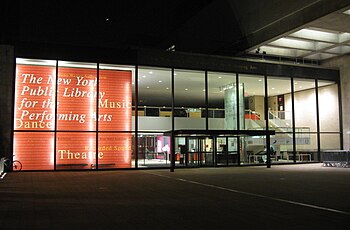
The New York Public Library for the Performing Arts' entrance from Lincoln Center Plaza at night
The New York Public Library for the Performing Arts, Dorothy and Lewis B. Cullman Center, at 40 Lincoln Center Plaza, is located in Manhattan, New York City, at the Lincoln Center for the Performing Arts on the Upper West Side, between the Metropolitan Opera House and the Vivian Beaumont Theater. Information technology houses i of the earth'southward largest collections of materials relating to the performing arts.[1] [2] [3] It is one of the four research centers of the New York Public Library's Enquiry library organization, and it is likewise one of the branch libraries.
History [edit]
Founding and original configuration [edit]

Originally the collections that formed The New York Public Library for the Performing Arts (LPA) were housed in two buildings. The Research collections on Dance, Music, and Theatre were located at the New York Public Library Main Co-operative, now named the Stephen A. Schwarzman Edifice, and the circulating music drove was located in the 58th Street Library.
A separate center to house performing arts was showtime proposed past Carleton Sprague Smith (chief of the Music Partition) in a 1932 report to the library administration, "A Worthy Music Center for New York."[four] (At the time, dance materials and audio recordings were all part of the Music Segmentation.) In that location were attempts to create partnerships with Rockefeller Center (nether structure at the fourth dimension), the Museum of Modern Art, and the Metropolitan Museum of Fine art (to which New York University wanted to join as a partner). During the late 1930s and early 1940s, the Music Sectionalisation produced a programme of concerts (based on the model of the Library of Congress concerts in Coolidge Auditorium). These concerts were often held in conjunction with the Metropolitan Museum of Art and Juilliard School, and the plan grew to include Lectures from New York University staff.
After Lincoln Center was incorporated in 1956, an early on mention of a possible "library and museum of the performing arts" appeared in June 1957.[five] Information technology was envisioned that a library-museum would serve to "interpret and illuminate the entire range of the performing arts."[6] Past December of that year, the library had go an accepted component of Lincoln Center planning and fundraising.[vii] Recalling his earlier reports, Smith produced a new report arguing for a motion to Lincoln Centre. Library administration officially approved of the motility in June 1959.[viii]
The building housing the library's enquiry collections and the Vivian Beaumont Theater was the third building to be opened at Lincoln Center.[9] Original plans conceived the library as a separate building, but prohibitive costs necessitated a combination of the Library and the Theater. As built, the Theater forms the cardinal core of the edifice, the 1st and 2nd floors occupying the southern and western sides, and the 3rd floor research collections providing a roof. Noted modernist architect Gordon Bunshaft, of the house of Skidmore, Owings and Merrill (SOM) designed the interiors, and SOM consulted with Eero Saarinen and Assembly (architect for the Vivian Beaumont Theater) on the exteriors.[10] The Claire Tow Theater (belonging to Lincoln Middle Theater) was built on the roof of the Library and opened in June 2012.
The third floor, housing the research collections, opened to the public on July 19.[10] The entire library was opened to the public on November xxx, 1965, the 4th building to open at Lincoln Center.[11] At its opening, information technology was called "Library and Museum of the Performing Arts." The Library's museum component was named the Shelby Cullom Davis Museum in honor of an investment banker who contributed $i one thousand thousand to Lincoln Center for museum purposes.[eleven]
At its opening, the Library'southward main foyer at the Lincoln Center Plaza entrance housed a bookstore, a film viewing expanse, and a listening area. The 2d floor included a children's performing arts collection equally well as the Hecksher Oval, an enclosed space that could accommodate story-telling. Prior to the 2001 renovation, the children's drove was relocated to the Riverside Branch. The Hecksher Oval was removed every bit office of the renovation.
The Shelby Cullom Davis Museum spaces included small and separate areas in the Dance, Music, Sound annal and Theater research divisions. Bigger galleries were the Vincent Astor Gallery on the 2nd floor, and galleries on the lower level and 2nd floor.
2001 renovation [edit]
From 1998 through 2001, the edifice was airtight due to a $38 million renovation project designed by Polshek Partnership. (The renovation was unrelated to the Lincoln Center renovations which commenced soon after 2001.) During this fourth dimension, the research collections were serviced from the NYPL's Annex (at 10th avenue and 43rd street), and the circulating collections were housed at the Mid-Manhattan Library at 40th Street and 5th Artery. LPA reopened to the public on October 29, 2001, with its building newly named Dorothy and Lewis B. Cullman Center after a gift from the Cullmans (Dorothy was a trustee until she died; Lewis is still a trustee).[12]
During the renovation, the library was wired to enable installation of numerous computers on each floor. There are most 200 publicly attainable computers in the edifice.[thirteen] [ better source needed ] Nearly are restricted to utilize of the library itemize and electronic databases or viewing the library's audiovisual material, but a few provide full Net access. The renovation also created a Applied science Training Room, with twelve desktop computers for users and one for a teacher, besides every bit a projection screen.
Upon the building's original opening in 1965, each research partitioning had a separate reading room. The renovation removed these and consolidated public areas into a single unified public reading surface area, with separate rooms for the Theater on Flick and Tape Annal (its screening room named for Lucille Lortel) and Special Collections (its room named for Katharine Cornell and Guthrie McClintic). Afterward the Special Collections reading room was moved into a portion of the main reading area of the 3rd floor, while a screening room for films held by the Jerome Robbins Trip the light fantastic Sectionalization and the Reserve Flick and Video Collection (originally part of the Donnell Media Center, but absorbed into the Collection in 2008) took its place. Meanwhile, gallery space for the museum was consolidated into 2 main gallery spaces with smaller areas for display of other items. The Donald and Mary Oenslager Gallery is located on the first flooring, adjacent to the Lincoln Plaza entrance, while the Vincent Astor Gallery (formerly on the second floor) is now located on the lower level, adjacent to the Amsterdam Avenue entrance. A small expanse near the Lincoln Center Plaza archway houses caricaturist Al Hirschfeld'due south desk and chair. The main corridors on the kickoff and 2nd floors are used for smaller exhibitions. The third floor has numerous brandish cases highlighting rotating displays of thematic groupings of artifacts from the collections.
The renovation was not without detractors. Critic Joseph Horowitz criticized the tertiary floor in particular. Where previously each segmentation had its own reading room, the renovation united all public reading areas into one room, resulting in less intimacy and more noise.[14] Edmund Morris characterized the Special Collections reading room as "a charmless space...[which] exudes a dispirited air of neglect."[fifteen]
Enquiry collections [edit]
From its inception, LPA has had both a research component (funded generally with private money) and a branch library component (funded with significant money from New York Metropolis, the remainder coming from individual contributions).
Materials and formats [edit]

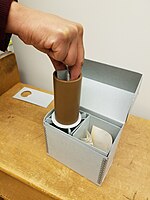
File cabinets contain over a million clippings at LPA

In addition to published works (for example, books, periodicals, and scores), the enquiry divisions collect an enormous amount of unique material: Archival cloth (material that was created by or that in one case belonged to an individual or organisation), text manuscripts, music manuscripts, dance notation scores, typescripts, prompt books, posters, original ready and costume designs, programs, and other ephemera are just some of the major categories of materials. The library's collection of sound recordings is in all formats that in themselves trace the history and development of sound recording.
The library has 500,000 folders containing clippings on a multifariousness of people and subjects pertaining to the performing arts. These clippings tin can sometimes provide a showtime to those at the initial stage of their inquiry. The library also collects a variety of iconography in various forms: photographs, lithographs, engravings, drawings, and others. A recent internal study estimated that LPA holds approximately 4.5 million photographs, including the recently caused drove of New York lensman Martha Swope, itself belongings i 1000000 photographs.
Much of this not-book cloth was non initially in the online catalog.[16] Some materials are accessible through in-house card files and indexes. Policy since changed to bring every bit much of the material as possible into the chief catalog, and by 2013, most of it was accessible in the catalog. Considering of the enormous book of material, some classes of it, such as the clipping files, has never been inventoried, although information technology is arranged in a retrievable manner with an alphabetical or chronological system. Unlike nearly U.S. public libraries, the research collections stacks are located in non-public areas and are not available for browsing. Patrons must make up one's mind what they want to view, fill out call slips, and submit the slips to library staff. Library staff then retrieves the cloth for the patron.
The holdings of LPA are divided by subject into divisions, which contain a number of special centers.
Music Division [edit]
The Music Division, as a founding division of The New York Public Library, is the oldest of all the divisions at LPA. Its origins stalk from the private library of banker Joseph William Drexel. Upon his expiry in 1888, his valuable library of 5,542 volumes and 766 pamphlets, known equally the Drexel Collection, became part of the Lenox Library. The Astor Library too had an endowment that helped with the purchase of music. In 1895, upon the Lenox Library's consolidation with the Astor Library, the Music Division became ane of the first bailiwick divisions of The New York Public Library.[17] [xviii]
Co-ordinate to The New Grove Dictionary of Jazz, the library has particular potent manuscript holdings in jazz, These include 400 of Benny Goodman'southward arrangements, and the arrangements made past Sy Oliver for musicians including Duke Ellington, Jimmie Lunceford, and Tommy Dorsey. It holds working scores of works by Ellington, and by Charles Mingus also as extensive microlim copies of Mingus' manuscripts.[19]
Classical music manuscript holding include manuscripts by Bach, Johannes Brahms, Franz Liszt, Glinka, Handel, Haydn, Korngold, Mozart, Paganini, Schubert, and Schumann.[20]
Billy Rose Theatre Division [edit]

The Library has been collecting theatrical materials for years prior to 1931, when the executors of David Belasco'southward estate offered the producer's holdings on the condition that a division be created. The Theatre Collection (every bit it was initially known) began on September one, 1931. The segmentation opened at Lincoln Center as the Theatre Drove. In 1956 the theatre collection of the New York Public Library was recognized with a Special Tony Laurels. In 1979, it was renamed the Billy Rose Theatre Division, honoring a financial souvenir from the lyricist/producer'south foundation. It is now the largest enquiry partitioning at the library, with holdings primarily on the theatre, and increasing on film, with some collections on the related subjects of vaudeville, magic, puppetry, and the circus.[ citation needed ] The Theater of Film and Tape Archive is administratively within the division.
The Theatre division includes the Theatre on Motion picture and Tape Archive (TOFT) which produces video recordings of New York and regional theater productions, and provides research access at its Lucille Lortel screening room. The drove is considered one of the virtually comprehensive collections of videotaped theater productions in the world.[21] Athenaeum modeled on TOFT include the Museum of Performance & Design in San Francisco, the Washington Area Performing Arts Video Annal established in Washington, D.C., and the National Video Annal of Operation in London. The core of the drove consists of live recordings of Broadway and Off-Broadway productions, with some additional productions from professional regional theaters. The Archive likewise records interviews and dialogues with notable theater professionals. In addition to alive performances, commercial recordings of theater-related films, documentaries, and television programs are also included in the collection. Currently between 50 and lx alive recordings are produced each year, covering most important productions. As of fall of 2016, the collection included 7,901 titles.[22]
Jerome Robbins Trip the light fantastic Division [edit]
The Jerome Robbins Trip the light fantastic Segmentation began in 1944 under the auspices of Genevieve Oswald.[23] Originally dance materials were part of the Music Division (when it was known as the "Trip the light fantastic Collection"), but its growth necessitated hiring a total-fourth dimension staff member in 1947.[24] Acquisitions were augmented past gifts of papers of Ted Shawn and Ruth St. Denis, Doris Humphrey, Charles Weidman, and Hanya Holm. With the souvenir of a collection of Walter Toscanini in laurels of his deceased wife, Cia Fornaroli (a dancer), the Dance Collection became an internationally known repository.[24] Due to its subsequent growth and increasing importance, the drove was formally recognized as a dissever sectionalisation on January 1, 1964.[25]
One of the division's most significant resources is the Jerome Robbins Archive of the Recorded Moving Epitome. Endowed with a gift from Jerome Robbins, this archive collects and preserves moving images of dance, making them available to researchers. The Archive has received many gifts from dancers and choreographers and contains many privately made films and video.[26]
The Sectionalization's oral history program began formally in 1965. These oral histories are particularly valuable since they provide information, history and context not generally bachelor in published sources.[27]
Reserve Moving-picture show and Video [edit]
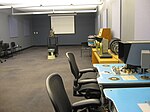
Screening room for the Reserve Film and Video collection; moviola and Steenbeck equipment are on the right
Though not technically a role of the Research divisions, the Reserve Moving picture and Video Drove (formerly the Donnell Media Center) is serviced from the third floor. For picture and video that must exist viewed onsite, there is a screening room (large enough for classes) equipped with a sixteen mm projector. At that place are likewise moviolas and Steenbeck equipment, permitting close frame-by-frame examination and assay.
Rodgers and Hammerstein Archives of Recorded Sound [edit]
The origins of the Rodgers and Hammerstein Archives of Recorded Sound can exist traced to a gift of 500 78-rpm records by Columbia Records in 1937 to the Music Partitioning. Successive gifts by tape companies and individuals led to the formal cosmos of a separate division with the opening of the building at Lincoln Center in 1965. It was named in substitution for a private donation from the Rodgers and Hammerstein arrangement.[28] Radio station WQXR donated 11,000 78 rpm recordings in 1966.[29] Carleton Sprague Smith envisioned the purpose of the sound archive as "stimulating interest amongst recording and broadcasting executives, likewise as other arts institutions that had potential for playing a cooperative role."[xxx] Resource include the Rigler-Deutsch Index, which lists of library's extensive holdings of 78 rpm records.
Co-operative (Circulating) Collections [edit]
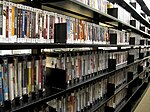
A portion of the circulating DVDs
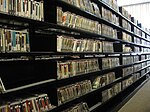
The beginnings of the circulating music collection are due in great part to its first head librarian, Dorothy Lawton.[31] Lawton took function in the establishment of the music collection at the 58th Street Library in 1920, beginning with a collection of 1,000 books and scores. In 1924, the circulating music collection was officially established as role of the 58th Street Library.[32] Her passion for trip the light fantastic toe enabled her to get unusual publications, so much that dance critic John Martin complimented her on the growing collection of trip the light fantastic toe books.[33]
In 1929, the 58th Street Library began a collection of recordings beginning with gifts from Victor and Columbia records, amounting to 500 records. Upon building a listening booth, Lawton reported that by 1933, the listening berth was constantly booked two weeks in advance.[34]
During World War Ii, she established a concert series for servicemen on Sundays from 3–7 PM. Servicemen could asking selections of their selection and could also participate in playing bedchamber music with instruments that had been loaned to the Library. She established the Orchestra Collection, a set of scores and parts that could be loaned to groups for operation. Currently, the Orchestra Collection loans parts to over 2,000 works.[35]
Upon Lawton'southward retirement in 1945, primary music critic of The New York Times Olin Downes complimented her on the development of the 58th Street Library, and remarked on her achievements such every bit attracting donors and enlisting the business concern and help of professional musicians.[36] (Many of the rare items that were gifts to the 58th Street Co-operative were subsequently moved to the Music Segmentation.)
Subsequently retiring, Lawton returned to the land of her nascency, England, and aid organize a newly created music collection at Central Music Library of the Buckingham Palace Route Library (today the Westminster Music Library), modeling the new library on the i she established at 58th Street.[31] [37] [38] Currently, the Circulating collections loan books on music, dance, theater, film, and arts administration. They likewise loan scores, scripts, CDs, videotapes, DVDs, and sets of orchestral parts.
Shelby Cullom Davis Museum [edit]
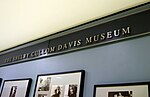
A display wall of the Shelby Cullom Davis Museum
The museum component of LPA takes the form of exhibitions in its 2 main exhibition spaces, The Donald and Mary Oenslager Gallery and the Vincent Astor Gallery, as well as a walled area in the plaza entrance, and additionally brandish cases distributed throughout the building. Among the purposes of the exhibitions is to show to all visitors that the millions of items belonging to the library are non for the exclusive utilize of scholars but for anyone who walks in the door.[39] Exhibitions highlights items from the library'due south collections and keep the name of the library before the public, attracting new and potential donations.[40]
Since the tardily 1990s, NYPL's exhibitions programme has added online exhibitions. Online exhibitions serve as an extension of concrete exhibitions, calculation more cloth or assuasive a greater depth of exploration.
Public programs [edit]
Public programs are complimentary of charge and have place in the 202-seat Bruno Walter Auditorium located on the lower level. The auditorium is used several times a week for musical performances, flick screenings and lectures.[41]
Come across also [edit]
- Carleton Sprague Smith
Further reading [edit]
- Sydney Beck, "Carleton Sprague Smith and the Shaping of a Great Music Library: Harbinger of a Center for the Performing Arts (Recollections of a Staff Member)" in: Libraries, History, Diplomacy, and the Performing Arts: Essays in Honor of Carleton Sprague Smith. Festschrift Series no. 9. Stuyvesant, NY: Pendragon Printing, 1991. ISBN 978-0-945193-13-5
- Miller, Philip L. and Frank Campbell, "How the Music Division Grew-A Memoir (parts one–2)." Notes vol. 35, no. 3 (March 1979), pp. 537–555; office 3: vol. 36, no. 1 (September 1979), pp. 76–77; office 4: Vol. 38, No. 1 (September 1981), pp. 14–41.
- Williams, Sam P. Guide to the Research Collections of the New York Public Library. New York: New York Public Library, 1975. ISBN 0-8389-0125-5
References [edit]
- ^ The New York Public Library. "New York Public Library for the Performing Arts, Dorothy and Lewis B. Cullman Center". Nypl.org. Retrieved February 12, 2013.
- ^ New York Public Library for the Performing Arts, Dorothy and Lewis B. Cullman Heart, accessed September four, 2011.
- ^ "New York Public Library for the Performing Arts | 40 Lincoln Eye Plaza". Timeout.com. October v, 2010. Retrieved February 12, 2013.
- ^ Beck, p. 20ff.
- ^ Howard Taubman, "Civic Pride: Metropolis Officials Should Work for Lincoln Center as a Municipal Necessity," The New York Times (June 2, 1957), p. 121.
- ^ Beck, p. 38.
- ^ "Commission Set Up To Seek Arts Fund," The New York Times (December two, 1957), p. 29.
- ^ Brook, p. 39.
- ^ Milton Esterow, "Beaumont Theater Opens at Lincoln Center," The New York Times (October 13, 1965), p. 1.
- ^ a b Allen Hughes, "Library and Museum 01 the Arts At Lincoln Heart Ready Presently," The New York Times (October 21, 1965), p. 57.
- ^ a b "Library-Museum of the Arts Opens at Lincoln Center," The New York Times (Dec 1, 1965), p. 55.
- ^ Mel Gussow, "Curtain Going Up at the Performing Arts Library", The New York Times (Oct eleven, 2001), p. E1.
- ^ Personal communication from IT staff, May 12, 2011.
- ^ Joseph Horowitz, "Quiet, Please. This Is a Library Afterward All", The New York Times (January 27, 2002), p. A31.
- ^ Edmund Morris, "Sacking a Palace of Culture", The New York Times (April 21, 2012), p. SR7.
- ^ A 1995 brochure indicated that 80% of the materials at LPA were non in the online catalog.
- ^ Williams, p. 142.
- ^ Much of the content of this section is derived from the thorough history of the Music Division through 1981 in a 4-part article: Philip L. Miller, Frank C. Campbell, Otto Kinkeldey, "How the Music Division of the New York Public Library Grew-A Memoir," Notes Vol. 35, No. 3 (March 1979), pp. 537–555 (parts one–two), Vol. 36, No. 1 (September 1979), pp. 65–77 (role three), Vol. 38, No. 1 (September 1981), pp. fourteen–41 (part 4).
- ^ "Libraries and archives." The New Grove Lexicon of Jazz, 2d ed.. Grove Music Online. Oxford Music Online. Oxford University Press, accessed March 28, 2013, [1].
- ^ Rita Benton. "Libraries." Grove Music Online. Oxford Music Online. Oxford University Press, accessed March 28, 2013, [2]
- ^ ["After the Final Curtain, Act II"], The New York Times (June ix, 2013).
- ^ 2016 Annual Report
- ^ Clive Barnes, "Dance: Collection Moves to New Home," The New York Times (Jan iv, 1966), p. 21.
- ^ a b Williams, p. 151.
- ^ Philip L. Miller, "How the Music Division Grew-A Memoir," Notes vol. 35, no. three (March 1979), p. 549.
- ^ Williams, pp. 151, 154.
- ^ Williams, p. 155.
- ^ Williams, p. 149.
- ^ "Lincoln Center Receives 11,000 Disks From WQXR," The New York Times (June nine, 1966), p. 53.
- ^ David Hall, "The Rodgers and Hammerstein Athenaeum of Recorded Sound, The New York Public Library at Lincoln Centre," in: Libraries, History, Diplomacy, and the Performing Arts: Essays in Honor of Carleton Sprague Smith, Festschrift Series no. 9 (Stuyvesant, NY: Pendragon Press, 1991), p. 43
- ^ a b "Dorothy Lawton, Librarian, 85, Dies," The New York Times (February 21, 1960), p. 92.
- ^ Circulating Music Collection, accessed September 5, 2011.
- ^ John Martin, "The Dance: A Treasury: Important New Volumes Added to Growing Collection at Library", The New York Times (October 4, 1931), p. 116.
- ^ Compton Pakenham, "Review of Newly Recorded Music," The New York Times (April fifteen, 1934), p. X6.
- ^ website, accessed September ix, 2011.
- ^ Olin Downes, "Librarian Retires: A Tribute to Dorothy Lawton-Her Contribution to Our Musical Life," The New York Times (July 8, 1945), p. xviii.
- ^ Olin Downes, "London Library: Music Establishment Formed Along Lines of 58th Street Co-operative Here," The New York Times (August 10, 1947), p. X6.
- ^ "London Library," The New York Times (November 14, 1948), p. X7.
- ^ Eleanor Blau, "Performing Arts Library Celebrates," The New York Times (May 29, 1991), p. C14.
- ^ Frank C. Campbell, "How the Music Division of the New York Public Library Grew-A Memoir, part four," Notes vol. 38, no. one (September 1981), p. xv.
- ^ Almost Public Programs at the Library for the Performing Arts.
External links [edit]
Coordinates: 40°46′22″N 73°59′03″W / 40.772831°N 73.984238°Westward / 40.772831; -73.984238
wagonerthallusithe.blogspot.com
Source: https://en.wikipedia.org/wiki/New_York_Public_Library_for_the_Performing_Arts
0 Response to "The Lincoln Center Library of the Performing Arts Monday July 15th at"
Mag-post ng isang Komento