Easy to Draw Girl With a 1700 Wig on Side View

A wig is a head or hair accessory made from human hair, animal hair, or constructed cobweb.[1] The word wig is short for periwig,[2] which makes its earliest known appearance in the English linguistic communication in William Shakespeare'southward The Two Gentlemen of Verona. Some people wear wigs to disguise baldness; a wig may be used as a less intrusive and less expensive alternative to medical therapies for restoring hair or for a religious reason.
History [edit]
Aboriginal and medieval utilize [edit]
In Egyptian society men and women commonly had clean shaven or close cropped hair and oftentimes wore wigs.[3] [4] The aboriginal Egyptians created the wig to shield shaved, hairless heads from the lord's day. They also wore the wigs on meridian of their hair using beeswax and resin to go on the wigs in place. Wealthy Egyptians would article of clothing elaborate wigs and scented head cones of animal fat on superlative of their wigs.[3] Other ancient cultures, including the Assyrians,[v] Phoenicians, Jews in aboriginal Israel,[half dozen] Greeks and Romans, also used wigs as an everyday way.
-

Egyptian couple wearing formal wigs of the 4th or fifth dynasties
-
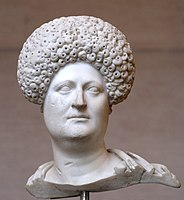
Bust of a Roman woman wearing a "diadem" wig, circa 80 CE
In Prc, the popularization of the wig started in the Jump and Autumn period.[seven] [ citation needed ]
In Japan, the upper classes started wearing wigs earlier the Nara period.[ citation needed ]
In Korea, gache were popular among women during the Goryeo dynasty until they were banned in the late 18th century.[ citation needed ]
16th and 17th centuries [edit]
After the fall of the Western Roman Empire, the utilise of wigs fell into disuse in the West for a yard years until they were revived in the 16th century as a means of compensating for pilus loss or improving one's personal appearance.[eight] They also served a practical purpose: the unhygienic atmospheric condition of the time meant that pilus attracted head lice, a problem that could exist much reduced if natural pilus were shaved and replaced with a more than hands de-loused artificial hairpiece.[9] Fur hoods were also used in a similar preventive way.
Royal patronage was crucial to the revival of the wig.[ten] Queen Elizabeth I of England famously wore a ruby wig, tightly and elaborately curled in a "Roman" fashion, while amongst men King Louis XIII of France (1601–1643) started to pioneer wig-wearing in 1624 when he had prematurely begun to baldheaded.[eleven] This fashion was largely promoted by his son and successor Louis XIV of French republic (1638–1715), which contributed to its spread in Europe and European-influenced countries since the 1660s.
Perukes or periwigs for men were introduced into the English-speaking earth with other French styles when Charles Two was restored to the throne in 1660, following a lengthy exile in France. These wigs were shoulder-length or longer, imitating the long hair that had become stylish among men since the 1620s. Their apply soon became popular in the English language court. The London diarist Samuel Pepys recorded the twenty-four hours in 1665 that a hairdresser had shaved his head and that he tried on his new periwig for the first fourth dimension, but in a twelvemonth of plague he was uneasy about wearing information technology:[12]
3rd September 1665: Up, and put on my coloured silk suit, very fine, and my new periwig, bought a good while since, just darst not wear information technology because the plague was in Westminster when I bought it. And it is a wonder what volition be the fashion after the plague is done as to periwigs, for nobody volition dare to buy any haire for fear of the infection? That it had been cut off the heads of people dead of the plague.
Wigs were not without other drawbacks, equally Pepys noted on March 27, 1663:
I did become to the Swan; and there sent for Jervas my old periwig-maker and he did bring me a periwig; but it was full of nits, and then as I was troubled to run across it (information technology being his old fault) and did send him to get in make clean.
With wigs virtually obligatory garb for men with social rank, wigmakers gained considerable prestige. A wigmakers' guild was established in France in 1665, a development shortly copied elsewhere in Europe. Their job was a skilled one every bit 17th century wigs were extraordinarily elaborate, roofing the back and shoulders and flowing downwards the chest; not surprisingly, they were as well extremely heavy and often uncomfortable to wear. Such wigs were expensive to produce. The all-time examples were made from natural human hair. The hair of horses and goats was often used every bit a cheaper alternative.[thirteen]
Several contemporary writings which have survived noted that some viewed men who wore wigs equally looking deformed and emasculated. It especially attracted disapproval from Puritans, and during times of plague, it was said that wigs were made of pilus of plague victims.[fourteen]
Wigs required cleaning using fullers earth, and the powder used to freshen it was fabricated from low course flour and scented with pomatum.[14]
Examples of wigs in the 16th and 17th century
-
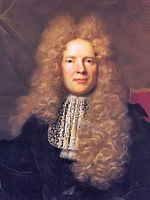
Nicolas de Vermont
-

Wigs 17th century
-
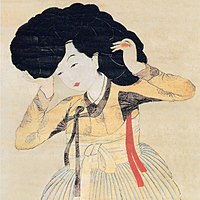
Korean traditional wig (Gache)
18th century [edit]


Wig, 1780–1800. Wigs that had the back pilus enclosed in a pocketbook were chosen handbag wigs.[15]
In the 18th century, men's wigs were powdered to give them their distinctive white or off-white color.[16] Women in the 18th century did not article of clothing wigs, just wore a coiffure supplemented by artificial pilus or hair from other sources. Powdered wigs (men) and powdered natural hair with supplemental hairpieces (women) became essential for full dress occasions and connected in use until nearly the end of the 18th century.
The elaborate form of wigs worn at the coronation of George 3 in 1761 was lampooned by William Hogarth in his engraving Five Orders of Periwigs. Powdering wigs and extensions was messy and inconvenient, and the development of the naturally white or off-white powderless wig (made of horsehair) for men made the retention of wigs in everyday court clothes a practical possibility. By 1765, wig-wearing went out of fashion except for some occupational groups such as coachmen and lawyers. During this period, people tend to but wear their natural hair, styled and powdered to resemble a wig. Nevertheless, the tendency revived extravagantly during the Macaroni period of the 1770s.[14] Women mainly powdered their hair grayness, or bluish-ish grey, and from the 1770s onwards never bright white like men. Wig pulverization was made from finely ground starch that was scented with orange flower, lavender, or orris root. Wig powder was occasionally colored violet, blueish, pink or yellow, but was most often fair.[17]
Past the 1780s, young men were setting a mode trend by lightly powdering their natural pilus, as women had already done from the 1770s onwards. Afterward 1790, both wigs and pulverization were reserved for older, more than conservative men, and were in apply past ladies being presented at court. Subsequently 1790, English women seldom powdered their hair.
In 1795, the British government levied a taxation on pilus pulverization of ane guinea per year. This tax effectively caused the demise of both the fashion for wigs and powder. Granville Leveson-Gower, in Paris during the winter of 1796, at the height of the Thermidorian Directory, noted "The word citoyen seemed only very picayune in use, and hair powder beingness very common, the appearance of the people was less democratic than in England."[18]
Among women in the French court of Versailles in the mid-to-tardily 18th century, large, elaborate and often themed wigs (such as the stereotypical "boat poufs") were in faddy. These combed-up hair extensions were oftentimes very heavy, weighted down with pomades, powders, and other ornamentation. In the late 18th century these coiffures (along with many other indulgences in court life) became symbolic of the decadence of the French nobility, and for that reason quickly became out of fashion from the beginning of the French Revolution in 1789.
During the 18th century, men'south wigs became smaller and more formal with several professions adopting them as part of their official costumes. This tradition survives in a few legal systems. They are routinely worn in various countries of the Commonwealth. Until 1823, bishops of the Church building of England and Church of Republic of ireland wore ceremonial wigs. The wigs worn by barristers are in the style favoured in the tardily eighteenth century. Judges' wigs, in everyday utilize as court dress, are short like barristers' wigs (although in a slightly different style), only for ceremonial occasions judges and also senior barristers (QCs) vesture full-bottomed wigs.[19]
Examples of 18th century wigs
-

Marie Antoinette wearing the distinctive pouf way coiffure; her ain natural hair is extended on the acme with an artificial hairpiece.
-

-

Colonel James Hamilton past John Smart (1784), wearing a white wig powdered with pink-coloured powder
19th and 20th centuries [edit]
Due to the association with ruling classes in European monarchies the wearing of wigs as a symbol of social status was largely abandoned in the newly created republics, the United States and France, by the start of the 19th century. In the United states, merely four presidents, from John Adams to James Monroe, wore curly powdered wigs tied in a queue co-ordinate to the former-fashioned style of the 18th century, though Thomas Jefferson did non always vesture a wig, simply merely wore a wig when he was Ambassador to France with his long red pilus unsaid to be curt until his terms as secretarial assistant of state, vice president, and president, in which he powdered his long hair.[twenty] Different them, the showtime president, George Washington, never wore a wig; instead, he powdered, curled and tied in a queue his own long hair.[21]
Women'southward wigs developed in a somewhat different fashion. They were worn from the 18th century onwards, although at first only surreptitiously. Full wigs in the 19th and early on 20th century were not fashionable. They were often worn by one-time ladies who had lost their hair.[ citation needed ] In the movie Mr. Skeffington (1944), Bette Davis's character has to wearable a wig afterward a bout of diphtheria, which is a moment of desolation and a symbol of her frailty.[ citation needed ]
During the late nineteenth and early twentieth century hairdressers in England and France did a brisk business supplying postiches, or pre-made modest wiglets, curls, and imitation buns to exist incorporated into the hairstyle. The use of postiches did not diminish even as women's hair grew shorter in the decade between 1910 and 1920, but they seem to have gone out of fashion during the 1920s.[22] In the 1960s a new type of synthetic wig was developed using a modacrylic fiber which made wigs more affordable. Reid-Meredith was a pioneer in the sales of these types of wigs.[23]
Presidents of the Usa in powdered wigs
21st century [edit]
The art of wigs became a billion dollar industry in the 21st century. Three main processes happen within the industry: the collection of material, manufacturing, and distribution. Bharat is the principal source of hair. It has been reported from time to fourth dimension that for global human being pilus merchandise, women from the Asean region are existence exploited.[24] Hair from this region has a significant commercial value in the international market.[25] Specially in India, the women are forced by their husbands into selling their pilus,[26] and slum children were being tricked into "having their heads shaved in exchange for toys".[27] Flake pickers are another source of hair in India, these people detect hair in miscellaneous places such as hair brushes, apparel, or in the trash. While manufacturing and processing, mainly takes place in China. Hither the hair is sorted through and constructed into wigs. Afterward, the distribution of the final product to is sent to different areas, with the top countries being the Us and the United Kingdom.[28]
Official use [edit]
In Britain, near Commonwealth nations, and the Democracy of Ireland special wigs are too worn past barristers, judges, and certain parliamentary and municipal or borough officials equally a symbol of the role. Hong Kong barristers and judges continue to wear wigs as part of court dress as a legacy of the court organization from the time of British dominion. In July 2007, judges in New South Wales, Australia, voted to discontinue the wearing of wigs in the NSW Courtroom of Entreatment.[29] New Zealand lawyers and judges have ceased to wear wigs except for formalism occasions, such as when newly-qualified lawyers are called to the bar. In Canada lawyers and judges do not wear wigs.
Entertainment [edit]
A number of celebrities, including Donna Summer, Dolly Parton, Sia, Nicki Minaj, Katy Perry, Melanie Martinez, Lady Gaga, Diana Ross & The Supremes, Tina Turner and Raquel Welch, popularized wigs. Cher has worn all kinds of wigs in the last 40 years, from blonde to black, and curly to straight. They may as well exist worn for fun every bit part of fancy dress (costume wearing), when they can be of outlandish color or made from tinsel. They are quite common at Halloween, when "rubber wigs" (solid bald cap-like hats, shaped like hair), are sold at some stores.
Wigs are used in film, theater, and television. In the Japanese film and television genre Jidaigeki, wigs are used extensively to modify appearance to reverberate the Edo period when almost stories have place. Only a few actors starring in large-budgeted films and television series will grow their hair so that it may be cut to the appropriate hair style, and forgo using a wig.
In the theater, specially on Broadway, wigs are used to give a performer a stock-still grapheme. Nearly all women and many men exercise so not only for graphic symbol blueprint, merely also to cover their microphone packs. Often the microphone pack goes on the actor's head, mainly to efficiently facilitate quick changes.
An thespian not wearing a wig needs to change their expect every fourth dimension they go on stage. The wig helps solidify the character's pattern; natural hair is different mean solar day to mean solar day.[30] [31]
Convenience [edit]
Wigs are worn by some people on a daily or occasional basis in everyday life. This is sometimes washed for reasons of convenience, since wigs can be styled ahead of time. A common practice of wigs for convenience is called protective styling. Many utilise wigs to avert harm to their natural tresses, or to create styles that may non be possible otherwise. [32]They are besides worn by individuals who are experiencing hair loss due to medical reasons (most commonly cancer patients who are undergoing chemotherapy, or those who are suffering from alopecia areata).
Some men who crossdress every bit women vesture wigs in different styles to make their hair seem more feminine.
Merkin [edit]
A merkin is a pubic wig oftentimes worn as a decorative item or for theatrical and mode purposes. They are sometimes viewed as erotic and some designs are meant for entertainment or equally a form of comedy.
Image gallery [edit]
Examples of contemporary wigs
-
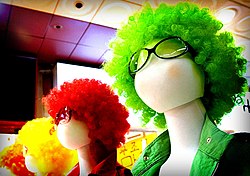
Colourful wigs for costume parties
-

An assortment of wigs in brandish cabinet
-
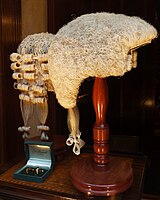
Wigs equally court apparel
-

Japanese wig for traditional hairstyle
Military wigs [edit]
From the late 17th to early 19th centuries, European armies wore uniforms more or less imitating the civilian fashions of the time, but with militarized additions. Equally part of that uniform, officers wore wigs more suited to the drawing rooms of Europe than its battlefields. The late 17th century saw officers wearing full-bottomed natural-coloured wigs, but the noncombatant alter to shorter, powdered styles with pigtails in the early on 18th century saw officers adopting similar styles. The elaborate, oversized court-styles of the tardily 18th century were not followed past armies in the field however, equally they were impractical to withstand the rigours of war machine life and simpler wigs were worn.
While officers normally wore their own hair short under a powdered wig, the rank and file of the infantry was not afforded such luxury. Instead of wigs, the men grew their hair long and according to the prevailing style in a nation's army, pilus was either allowed to abound long with unproblematic modeling, as in the French army of the 1740s, or else was elaborately coiffured equally in Prussian and British armies. In the example of British soldiers of the 1740s, contemporary artwork suggests that they cut their hair curt, which was not the case. Instead, the men used tallow or other fat to grease the hair, which was then fashioned into pigtails and tied back into the scalp hair to requite the impression of curt pilus.[33] Information technology was then liberally dusted with powdered chalk to requite the impression of a powdered wig. Later in the century, hair was likewise tied back, greased and powdered, just faux hair pigtails were adopted, kept in a tubular queue and tied back with ribbons to the soldier's own hair. The overall effect was that of a wig with a long tail and bow. The Prussian army took personal hairstyles to an extreme during the time of Frederick the Not bad, each soldier usually having a long pigtail hanging down the dorsum about to waist level.
By contrast, in the 1780s Russian General Potemkin abhorred the tight uniforms and uncomfortable wigs and powdered coiffures worn past his soldiers and instigated a consummate revision of both. Along with comfy, practical, well-plumbing fixtures uniforms, his reforms introduced keen, natural hairstyles for all, with no wigs, pulverization and grease, or pilus-tying axiomatic.
Formal military hairstyles lasted until beyond the cease of the 18th century and it was the French Revolution which spelled the end of wigs and powdered, greased hairstyles in modern, Western armies. Powdered hair and pigtails made a brief return during Napoleon's reign, existence worn by infantry of his Pes Grenadiers and Foot Chasseurs of the Old Guard and the Horse Grenadiers of the Guard.
Religious [edit]
Judaism [edit]
Jewish police requires married women to comprehend their hair for reasons of tzniut (Hebrew: "modesty or privacy"). Some Orthodox Jewish women wear wigs, known as sheitels, for this purpose. Wigs of those who do Haredi Judaism and Hasidic Judaism frequently are fabricated from human hair. In Modern Orthodox Judaism, women will usually clothing a scarf, kerchief, snood, hat or other roofing, sometimes exposing the lesser of their pilus.
One rabbi has alleged that long wigs are inappropriate.[34] Another said that information technology is preferable for a married Jewish woman to expose her hair than to don a wig, for the wig really increases attraction in the public domain and encourages the notion that Halakha is both irrational and intellectually dishonest.[35] Still another rabbi, who also spoke strongly against the wearing of wigs, said specifically, "You must get with a hat or kerchief on your head", but did not permit leaving hair "exposed".[36]
Most Orthodox women cover their pilus,[37] whether with wigs, hats or scarves. The rejection past some rabbis of wigs is not recent, but began "in the 1600s, when French women began wearing wigs to comprehend their pilus. Rabbis rejected this do, both because it resembled the contemporary not-Jewish style and because it was immodest, in their eyes, for a woman to sport a cute head of hair, even if it was a wig."[38]
Other options include:
- wearing a covered wig, called a shpitzel
- a covering, typically cloth, called a tichel
- another non-hair (and looser) head covering, called a snood
- a brusk wig generally covered by a Tichel, but with (wig) "pilus" showing on the forehead, sometimes also showing from the dorsum, chosen a frisette
Manufacture [edit]
In the 18th and 19th centuries, wig makers were called perruquiers.[39]
There are two methods of attaching hair to wigs. The first and oldest is to weave the root ends of the hair onto a stretch of three silk threads to form a sort of fringe called a "weft". The wefts are and then sewn to a foundation made of net or other cloth.[40] In modern times, the wefts can as well be fabricated (a warp is the vertical thread of a weave, the weft is the horizontal thread) with a peculiarly adapted sewing automobile, reducing the amount of paw labour involved. In the 19th century some other method came into use. A small hook called a "ventilating needle" or "knotting needle", similar to the tambour hooks used for decorating material with concatenation-sew together embroidery at that period, is used to knot a few strands of hair at a time direct to a suitable foundation cloth. This newer method produces a lighter and more natural looking wig. High quality custom wigs, and those used for moving picture and theatrical productions are commonly washed this way. It is likewise possible to combine the ii techniques, using weft for the main part of the wig and ventilating hair at the edges and partings to give a fine end.

Measurement [edit]
Making custom wigs starts with measuring the subject's head. The natural pilus is arranged in flat curls against the head every bit the various measurements are taken. It is often helpful to make a pattern from layers of transparent adhesive tape applied over a slice of plastic wrap, on which the natural hairline tin can be traced accurately. These measurements are then transferred to the "block", a wooden or cork-blimp canvas grade the same size and shape as the client'due south head.[41] [42]
Foundation [edit]
Depending on the style of the wig, a foundation is made of net or other material, dissimilar sizes and textures of mesh beingness used for unlike parts of the wig. The edges and other places might be trimmed and reinforced with a narrow ribbon chosen "galloon". Sometimes flesh colored silk or synthetic material is applied where it volition show through the pilus at crown and partings, and small basic or elastic are inserted to make the wig fit deeply. Theatrical, and some fine custom wigs, take a fine, mankind colored net called "hair lace" at the front which is very inconspicuous in wear and allows the hair to await as if it is coming straight from the pare underneath. These are usually referred to as "lace front end wigs".[43]
Hair preparation [edit]
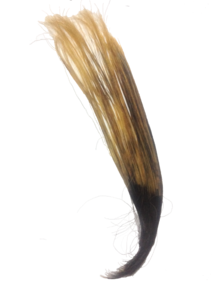
Trimmed homo pilus that is partly bleached.
Natural hair, either human or from an animal such as a goat or yak, must be advisedly sorted then that the direction of growth is maintained, root to root, and point to indicate. Because of the scale-like structure of the cuticle of a hair shaft, if some hairs get turned the wrong way, they will ride backwards against their neighbors and cause tangles and matting. The highest quality of hair has never been bleached or colored, and has been advisedly sorted to ensure the direction is correct. This procedure is called "turning". For less expensive wigs, this labour-intensive sorting process is substituted by "processing" the pilus. It is treated with a strong base solution which partially dissolves the cuticle leaving the strands smooth. It is and so bleached and dyed to the required shade and given a synthetic resin stop which partially restores the strength and luster of the now damaged hair. Synthetic cobweb, of course, is simply manufactured in the required colors, and has no direction.
The wigmaker will choose the type, length and colors of pilus required by the blueprint of the wig and blend them past pulling the hair through the upright teeth of a castor-similar tool called a "hackle" which besides removes tangles and any short or cleaved strands. The hair is placed on one of a pair of short-bristled brushes called "drawing brushes" with the root ends extending over one edge; the border facing the wigmaker (or properly called, boardworker), and the second castor is pressed down on height of it and then that a few strands can be withdrawn at a time, leaving the remainder undisturbed.[43]
Adding the hair [edit]
Weft structured wigs can have the wefts sewn to the foundation by hand, while it is on the block or, as is mutual with mass-produced wigs, sewn to a ready-fabricated base of operations past skilled sewing machine operators. Ventilated (mitt knotted) wigs have the hair knotted direct to the foundation, a few strands at a time while the foundation is fastened to the cake. With the hair folded over the finger, the wigmaker pulls a loop of hair under the mesh, and then moves the hook forrard to catch both sides of the loop. The ends are pulled through the loop and the knot is tightened for a "single knot", or a second loop is pulled through the first before finishing for a "double knot". Typically, the bulkier but more than secure double knot is used over the bulk of the wig and the less obvious unmarried knot at the edges and parting areas. A skilled wigmaker volition consider the number of strands of hair used and the direction of each knot to give the near natural event possible.[44]
It takes generally six heads of pilus to make a full human hair wig.[ citation needed ]
Styling [edit]
At this point, the pilus on the wig is all the same length. The wig must exist styled into the desired course in much the same manner equally a regular stylist.[42]
Fitting [edit]
The subject's natural hair is again knotted tightly against the head and the wig is applied. Any remaining superfluous wiglace is trimmed abroad. Hairpins can exist used to secure the lace to the hair and occasionally, pare-safe adhesives are used to adhere the wig against bald skin and to better hide any exposed lace. Finishing touches are washed to the hair styling to attain the desired event.[42]
Types of human hair wigs [edit]
There are 2 bones kinds of hair wigs: The traditional machine stitched weft wig and the hand tied lace wig. The automobile stitched wigs are still the most widely worn wigs today. The hair is sewn on a stretch weft fabric and come up with back straps for adjusting to various head sizes. These wigs are typically pre-styled and lack any kind of realistic expectations.
Lace wigs are quickly becoming one of the well-nigh sought-after wigs among wig wearers. The illusion of hair growing from the scalp is the characteristic that makes this wig the best of the best when it comes to wearing false hair. These wigs are made with a French or Swiss lace material base. They are made as a total lace or partial lace front with a stretch weft back. Each hair strand is individually stitched into a lace material which creates the natural look of hair at the base of operations. This is where the term "hand tied" originates.
Hair type is the distinguishing factor in human pilus wigs. Four main types of hair are used in manufacturing: Chinese or "Malaysian", Indian, Indonesian or "Brazilian", and Caucasian or "European". The majority of human being hair wigs are made of Chinese or Indian hair, while European hair is considered the most expensive and rare, as virtually donors are from Russia or Northern Europe, where in that location is a smaller portion of pilus donors to the market.
Remy human hair is considered to be the all-time quality of human pilus because the cuticles are kept intact and not stripped away;[45] "strands retain their scaled natural outer cuticle."[46] The preserved cuticles are also aligned in a unidirectional style, which decreases tangling and matting. Likewise, the hair is advisedly separated after collecting from the donor to ensure all the cuticles are of the aforementioned length.[47]
Notable wig designers [edit]
- Nina Lawson, who ran the Metropolitan Opera wig department from 1956 to 1987
- Peter King, Bristol, Uk[48]
- Peter Owen, Bristol, United Kingdom[49]
- Willy Clarkson, who created wigs for London's West End theatre productions
Meet also [edit]

Wikimedia Commons has media related to Wigs.
- Hair extensions
- Hair prosthesis
- Toupée
References [edit]
- ^ "How is a Wig Made?".
- ^ 1600s, shortened form of the word Periwig "Define Wig at Lexicon.com".
- ^ a b c Wallenfels, Ronald (2000). The Aboriginal Near East: An Encyclopedia for Students, Volume 2. Scribner. p. 145. ISBN9780684805948.
- ^ Fletcher, Joann; Salamone, Filippo (2016). "An Ancient Egyptian Wig: Structure and Reconstruction". Internet Archæology (42). doi:10.11141/ia.42.six.3.
- ^ "Dumuzid and Jectin-ana". Etcsl.orinst.ox.ac.uk. December nineteen, 2006. Retrieved March 16, 2013.
- ^ Mishna tractate Sabbath Chapter 6 Mishna 5
- ^ Snodgrass, Mary Ellen (2015). World Clothing and Fashion: An Encyclopedia of History, Culture, and Social Influence. Routledge. pp. 119, 120, 121. ISBN9781317451679.
- ^ "Fashion: The history of the wig: On a wig and a prayer". Independent.co.britain. January 17, 1999.
- ^ "Perukes, Pomade, and Powder: Pilus Intendance in the 1700s". January 28, 2015.
- ^ "A Brief History of the Wig". June xv, 2015.
- ^ marcelgomessweden. "Louis XIII « The Beautiful Times". Thebeautifultimes.wordpress.com. Retrieved March sixteen, 2013.
- ^ Samuel Pepys; Henry Benjamin Wheatley (1895). The Diary of Samuel Pepys (Volume 9, Page 60).
- ^ Chaudhary, Amit (July 10, 2018). "History of Pilus Wigs - Why It is in Tendency Today - Artificial Heads of Hair". Planetofhaircloning.com.
- ^ a b c Cockayne, Emily (2021). Filth, Noise & Stench in England. Yale Academy Press. pp. 66–72.
- ^ McDowall, Carolyn. "Adventures in Hair for 18th Century Gentlemen". The Culture Concept Circle . Retrieved July 19, 2020.
- ^ "When Did Men Stop Wearing Wigs?". June 8, 2017.
- ^ "Hair Powder Revenue enhancement". July 22, 2013.
- ^ Noted in Janet Gleeson, Privilege and Scandal: The Remarkable Life of Harriet Spencer, Sister of Georgiana 2006:178.
- ^ "Judiciary.gov.britain". Retrieved Oct 5, 2014.
- ^ Whitcomb, John; Whitcomb, Claire (2002). Real Life at the White House: Two Hundred Years of Daily Life at America's Almost Famous Residence. Psychology Press. ISBN9780415939515 . Retrieved April twenty, 2010.
- ^ "Oftentimes Asked Questions: Did George Washington wear a wig?". The Papers of George Washington. Academy of Virginia. Archived from the original on Nov 20, 2005. Retrieved October 4, 2010.
- ^ Emile Long, Hairstyles and Fashion: A Hairdresser'southward History of Paris, 1910–1920, edited with an introduction past Steven Zdatny, Berg (Oxford International Publishers Ltd), 1999 ISBN ane-85973-222-4
- ^ "Expert Says Korean Labor Problems Knock Wig Market place Beveled". Associated Press. Baronial 3, 1988. Retrieved Oct 8, 2013.
- ^ "Association of southeast asian nations: Multi-billion hair industry exploits women past ownership pilus at very low prices | Business organization & Human Rights Resource Eye". world wide web.business organisation-humanrights.org . Retrieved March 4, 2020.
- ^ "Human being pilus trade is exploiting ASEAN women". The ASEAN Mail . Retrieved March four, 2020.
- ^ McDougall, Dan (June 24, 2006). "Merchandise in hair forces Republic of india'south children to pay the cost". The Observer. ISSN 0029-7712. Retrieved March iv, 2020.
- ^ Khaleeli, Homa (October 28, 2012). "The hair trade's dirty cloak-and-dagger". The Guardian. ISSN 0261-3077. Retrieved March 4, 2020.
- ^ Boland, Rosita. "The Hair Collectors: Where Wigs and Hair Extensions Come From." The Irish Times, half-dozen April. 2019, https://www.irishtimes.com/life-and-way/style/beauty/the-hair-collectors-where-wigs-and-hair-extensions-come-from-1.3848296.
- ^ "Woolly headed? Not this verdict". The Sydney Morning Herald. August 2, 2007.
- ^ Archived at Ghostarchive and the Wayback Machine: American Theatre Fly (Oct 28, 2013). "Theatrical Wig Maker". YouTube. Retrieved April two, 2019.
- ^ Archived at Ghostarchive and the Wayback Machine: American Theatre Fly (Oct 10, 2018). "Working in the Theatre: Wigs". YouTube. Retrieved April 2, 2019.
- ^ Forbes, Jihan. "Wigs Are Cool and All, But Do They Really Give Us a Break from Styling?" Allure, 27 Dec. 2021, https://www.allure.com/story/are-we-over-wigs/amp.
- ^ "Pigtails, Queues, and Campaign Wigs of Revolutionary War Soldiers". October 16, 2014.
- ^ "Rabbi Says Long Wigs Are Not Proper Head Coverings". Crownheights.info. Retrieved November seven, 2013.
- ^ Archived at Ghostarchive and the Wayback Machine: "Are Wigs Kosher? Interview with Machon Shilo's Rabbi David Bar-Hayim", Torah Nation, YouTube, Feb half dozen, 2016, retrieved March 23, 2017
- ^ Ari Galahar (September half dozen, 2010). "Rabbi Yosef comes out against wig-wearing". Ynetnews.
- ^ Frimet Foldberger (August 4, 2014). "Taxonomy of the Sheitel". The Forward.
- ^ Alieza Salzberg. "Hair Coverings for Married Women".
- ^ "Perruquier'southward Shop, England, 18th century. Analogy of maker of perukes or wigs".
maker of perukes
- ^ Huaixiang, Han (June 20, 2014). Costume Craftwork on a Budget. Burlington, MA: Focal Press. pp. 86–87. ISBN978-0240808536 . Retrieved November 21, 2014.
- ^ "The Art and Craft of Hairdressing", Wolters.
- ^ a b c "Wigs". How It's Made. Season 6. Episode half dozen–06. Discovery Aqueduct Canada.
- ^ a b "The Art and Arts and crafts of Hairdressing" Wolters
- ^ "The Art and Arts and crafts of Hairdressing" ed. N.E.B. Wolters, The New Era Publishing Company, Ltd. London, 1963
- ^ "Hair Extension Thefts on the Rise". The New York Times. May 16, 2011.
sold with its outermost cuticle layer intact.
- ^ Crystal Martin (May 15, 2019). "We Fabricated Gray Hair Fifty-fifty Prettier With Pastels". The New York Times.
- ^ Lauren Lipton (February 27, 2013). "Her Crowning Glory in a Box". The New York Times.
kept in the same management afterwards harvesting
- ^ "Peter Swords King". IMDb . Retrieved August 29, 2014.
- ^ "Peter Owen". IMDb . Retrieved August 29, 2014.
Further reading [edit]

Look up wig in Wiktionary, the costless lexicon.
- Chisholm, Hugh, ed. (1911). . Encyclopædia Britannica. Vol. 28 (11th ed.). Cambridge Academy Press. pp. 624–625.
- Emma Tarlo (2016). Entanglement: The Secret Lives of Pilus. Oneworld Publications. ISBN978-1780749921.
wagonerthallusithe.blogspot.com
Source: https://en.wikipedia.org/wiki/Wig
0 Response to "Easy to Draw Girl With a 1700 Wig on Side View"
Mag-post ng isang Komento