There Are How Many Members in the House of Representatives
The U.S. House of Representatives has ane voting member for every 747,000 or so Americans. That'due south by far the highest population-to-representative ratio among a peer group of industrialized democracies, and the highest it's been in U.Due south. history. And with the size of the Business firm capped by constabulary and the country'southward population continually growing, the representation ratio probable will only get bigger.
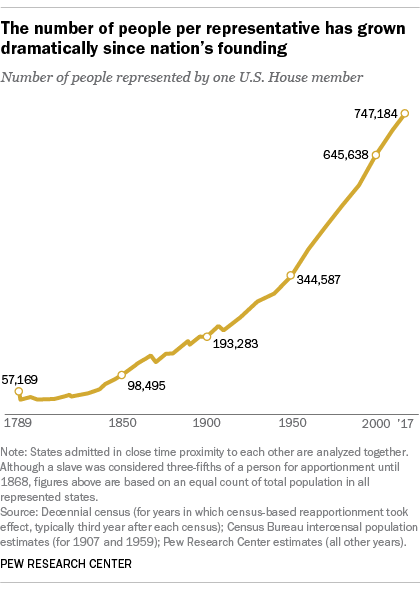
In the century-plus since the number of House seats first reached its electric current total of 435 (excluding nonvoting delegates), the representation ratio has more tripled – from one representative for every 209,447 people in 1910 to ane for every 747,184 equally of terminal year.
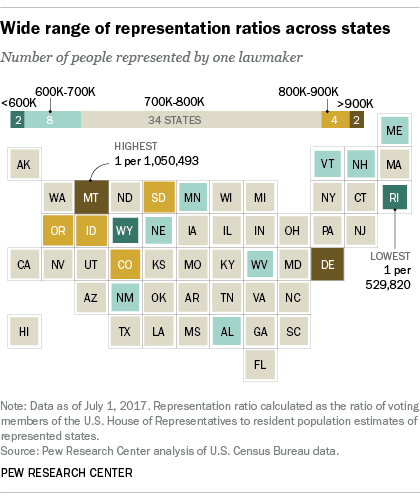 That ratio, mind y'all, is for the nation equally a whole. The ratios for individual states vary considerably, mainly considering of the Firm's stock-still size and the Constitution'south requirement that each state, no affair its population, have at least one representative. Currently, Montana's 1,050,493 people have but one House member; Rhode Island has slightly more people (1,059,639), but that'due south enough to give it two representatives – one for every 529,820 Rhode Islanders.
The U.S. findings in this post are based on Pew Research Center analyses of House membership changes since 1789 and historical population data (actual when available, estimated when not). They exclude territories, the District of Columbia and other U.Due south. possessions that don't accept voting representation in the House. The analysis was complicated somewhat by the fact that new states oft were admitted later on a decennial census just earlier the apportionment police force based on that census took outcome (unremarkably most three years afterwards). In such cases, the new states were analyzed as if they had been states at the time of the demography.
How the House reached 435
The first Congress (1789-91) had 65 Firm members, the number provided for in the Constitution until the showtime census could be held. Based on an estimated population for the 13 states of 3.7 1000000, at that place was i representative for every 57,169 people. (At the fourth dimension, Kentucky was part of Virginia, Maine was part of Massachusetts, and Tennessee was part of North Carolina. Vermont governed itself as an independent democracy, despite territorial claims past New York.)
By the time the first apportionment bill took upshot in March 1793, Vermont and Kentucky already had joined the Union; the 15 states had a total population of iii.89 million. Since the apportionment law provided for 105 Firm members, there was one representative for every 37,081 people. (Co-ordinate to the Constitution at the fourth dimension, simply iii-fifths of the nation's 694,280 slaves were counted for circulation purposes; using that method, the ratio was approximately one representative for every 34,436.)
For more than a century thereafter, as the U.South. population grew and new states were admitted, the House'southward membership grew too (except for ii short-lived contractions in the mid-1800s). The expansion generally was managed in such a mode that, fifty-fifty as the representation ratio steadily rose, states seldom lost seats from i apportionment to the next.
That procedure ran aground in the 1920s. The 1920 demography revealed a "major and continuing shift" of the U.S. population from rural to urban areas; when the fourth dimension came to reapportion the Firm, as a Demography Bureau summary puts it, rural representatives "worked to derail the process, fearful of losing political ability to the cities." In fact, the House wasn't reapportioned until after the 1930 census; the 1929 law authorizing that census as well capped the size of the House at 435. And there it has remained, except for a brief flow from 1959 to 1963 when the chamber temporarily added two members to represent the newly admitted states of Alaska and Hawaii.
There have been occasional proposals to add more seats to the House to reflect population growth. One is the and so-called "Wyoming Rule," which would brand the population of the smallest state (currently Wyoming) the footing for the representation ratio. Depending on which variant of that rule were adopted, the House would have had 545 to 547 members following the 2010 census.
However, a recent Pew Research Center survey constitute limited public support for adding new Firm seats. Simply 28% of Americans said the House should be expanded, versus 51% who said it should remain at 435 members. When historical context was added to the question, support for expansion rose a fleck, to 34%, with the additional support coming mainly from Democrats.
How the U.S. compares globally
The Firm's hefty representation ratio makes the The states an outlier among its peers. Our inquiry finds that the U.Southward. ratio is the highest among the 35 nations in the Organization for Economical Cooperation and Development, most of them highly developed, autonomous states.
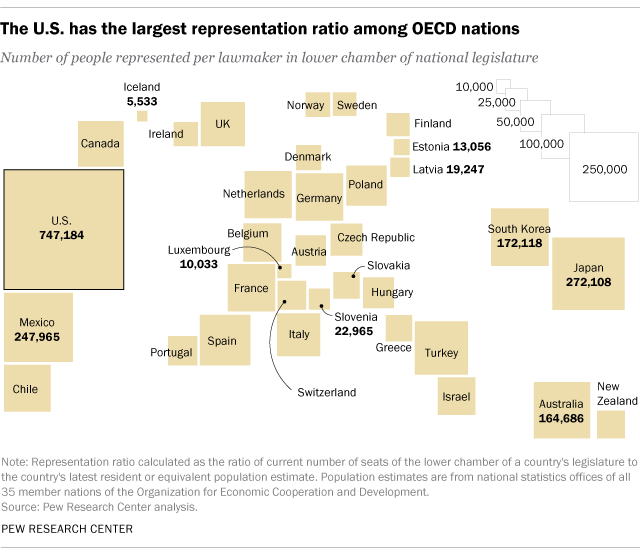 We took the most recent population estimate for each OECD nation and divided it past the current number of seats in the lower bedchamber of each national legislature (or, in the instance of unicameral bodies, the single bedchamber). After the U.S., the ii countries with the highest representation ratios are Nihon (i lawmaker for every 272,108 Japanese) and Mexico (i for every 247,965 Mexicans). Republic of iceland had the lowest ratio: one member of the Althing for every v,500 or so Icelanders.
While much of the cross-national disparity in representation ratios can be explained by the big population of the U.S. (with more than than 325 million people it'due south the largest land in the OECD), that's not the simply reason. Viii OECD countries have larger lower chambers than the U.South. House, with Germany's Bundestag topping the league table with 709 members. The British House of Commons has 650 MPs (Members of Parliament); Italy'due south Sleeping accommodation of Deputies has 630 lawmakers.
Even if Congress decided to expand the size of the House, the large U.Due south. population puts some practical limits on how much the representation ratio could be lowered. If the Firm were to grow as big as the Bundestag, for instance, the ratio would autumn just to one representative per 458,428 people. In order to reduce the ratio to where it was afterward the 1930 census, the Business firm would demand to have 1,156 members. (That would still exist smaller than Cathay'south National People'south Congress, the largest national legislature in the globe with 2,980 members.)
wagonerthallusithe.blogspot.com
Source: https://www.pewresearch.org/fact-tank/2018/05/31/u-s-population-keeps-growing-but-house-of-representatives-is-same-size-as-in-taft-era/
0 Response to "There Are How Many Members in the House of Representatives"
Mag-post ng isang Komento