Does the Size of Rain Drops Affect Rain Gauge Reading

Rain Drop Measurement Techniques: A Review
Stormwater Research Group, Schoolhouse of Science and Engineering, University of the Sunshine Coast, Sippy Downs, Queensland 4556, Australia
*
Author to whom correspondence should exist addressed.
†
These authors contributed equally to this work.
Academic Editor: Brigitte Helmreich
Received: 17 November 2015 / Revised: 15 Dec 2015 / Accepted: 4 January 2016 / Published: 21 Jan 2016
Abstract
For over a century there have been many studies that describe the use of rain drop measurement techniques. Initial manual measurement methods evolved due to improved engineering science to include photographic and, more recently, automated disdrometer and laser measurement techniques. Despite these numerous studies, in that location have been few comparative reviews of the range of methodologies, and their relative operation. This review explores the raindrop measurement techniques available, and summarizes and classifies the techniques co-ordinate to the method or principle involved. The requirements of a robust raindrop measurement technique are suggested, and these are reviewed against existing rain driblet measurement techniques to provide a comparative guide to the use of the range of techniques available for any research report. This review revealed that while advances in applied science have immune many of the deficiencies of early on techniques to be eliminated, challenges remain in relation to the precision of the measurement of the size, shape, and velocity of rain drops.
i. Introduction
An appreciation of rain drib characteristics such as size, shape, velocity, kinetic energy, and drib size distribution is crucial for many scientific, commercial and industrial applications. Some examples of these include remote sensing, meteorology (weather prediction), telecommunication (signal baloney), and agriculture and horticulture (ingather yield) radar meteorology, atmospheric physics, cloud photodetection, and measurement of tropospheric precipitation microstructure [1,2,3].
The characteristics of pelting drops are also important for stormwater management purposes, particularly in relation to understanding how pollution wash off processes affect stormwater quality. For case, larger rain drops that possess more kinetic free energy are known to result in higher pollution concentrations being washed off impervious surfaces and into downstream aquatic environments [4].
The objective of this review is to provide a summary of the evolution of rainfall measurements techniques, and to review and compare the different rain drop measurement techniques used in previous research studies. The telescopic of this review has been express to include but those measurement techniques with the ability to measure rain drib size, shape, distribution, velocity, kinetic free energy, and intensity. Different raindrop measurement techniques have been characterised according to the method used, and the relative merits of each method are discussed. In order to compare the merits of each technique, rain drop measurement methods included in this review have been broadly categorised into manual and automated techniques.
Manual rain drop measurement techniques include the stain method (measurement of stains on dyed absorbent newspaper), flour pellet method (measurement of pelting drops that fall into finely sieved flour and produce dough pellets), and oil immersion method (measurement of pelting drops in a vessel containing oil). Despite these transmission methods being simple, they are time consuming, take limited measurement accuracy, and practise not give real time data records. Also, these manual techniques cannot provide terminal velocity data, which is required to guess the kinetic energy of rainfall [5]. Manual techniques are reviewed in the start part of this article.
Recent advances in engineering and electronics have enabled an exploration of automatic rain drop measurement techniques. These are reviewed in the 2nd part of this article and include techniques such as the using devices to measure the displacement and mechanical free energy caused by raindrops striking a surface, optical imaging to measure the velocity, diameter, and shape of the raindrops using camera technology, acoustic techniques which measure the noise produced by rain drops striking a diaphragm and optical scattering, whereby pelting drop size, shape, velocity, and diameter are measured passing through a lite or laser axle.
In the terminal department of this article, the essential characteristics required for an accurate pelting drop measurement technique are suggested and explained. A summary and conclusions of the review are presented.
2. Manual Rain Drib Measurement Techniques
Early studies (ca. 1900–1960) attempted to describe rain drop size and velocity using manual measurement techniques such every bit chemically treated paper, and carbohydrate or soot coated nylon screen [vi,7,8]. These very early, functional techniques were constitute to provide inaccurate results, and accept been superseded due to technological advancement over the last century.
2.one. Stain Method
The stain method was one of the primeval accepted techniques to be developed and it is still in use today. First described by Lowe [ix], this method involves the use of chemically treated paper to measure the size of raindrops. For a curt period of time rain drops are allowed to land on a canvas of absorptive paper covered with a h2o-soluble dye. A variety of absorptive papers accept previously been used including filter paper, blotting newspaper, blueprint paper, paper towelling, photographic paper, and adding machine tape. Upon impact, the embedded dye reacts with the rain drops and this leaves permanent marks on the newspaper. The marks are and then carefully measured and counted to provide information nigh the rain drops. One of the limitations of this method is that during prolonged sampling, the rain drop stains tin overlap, which can make it difficult to accurately measure out and count individual drops.
Several iterations of this method over time improved measurement accuracy, and increased size range measurement chapters including developments of the method described by Marshall and Palmer [10], and Marshall et al. [11] who used dyed filter newspaper. Ii filter papers were used simultaneously to increment the accurateness of pelting drop measurement. Ink blotters dusted with potassium manganese used past Anderson [12] and known water densities used by Abudi et al. [13], incorporated weights of raindrops to infer size. Several studies [14,xv,sixteen,17,eighteen,19,xx,21,22] used Whatman's No. i filter newspaper, which was identified equally yielding the most authentic results.
Bowen and Davidson [23] trialled an improvement to the stain method by using a semi-automatic technique which produced a continuous record of the drib size distribution. The improved method involved deflection of rain drops onto moving absorbent newspaper embedded with dye. The diameters of the stains were categorised into 5 different size classes, from which drop size distributions were calculated. A similar recording musical instrument in which newspaper record was used to tape rain drops was developed in conjunction with an equation which described drop size in relation to stain size and time lag between sampling and analysis [24,25,26,27]. Calculations resulted in a calibration chart which translated the stained area caused past rain drops into raindrop diameter [14,15]. Limitations of this methodology included the uncertainty of assuasive for concluding velocity of the rain drop prior to measurement [fifteen,28,29], and maintenance of paper temperatures, which were both plant to influence stain sizes [30].
2.two. Flour Pellet Method
First adult in 1904 by Bentley [31], the flour pellet method (Figure 1) was used to study driblet size distributions of rain events in Washington D.C., USA. A number of studies have since used slightly different versions of the flour pellet method to successfully analyse rainfall (Table ane).
Figure 1. (a) Raindrop flour pellet samples nerveless in a pan filled with two cm depth of plain flour; (b) Flour pellets after oven drying.
Figure 1. (a) Raindrop flour pellet samples collected in a pan filled with 2 cm depth of plain flour; (b) Flour pellets after oven drying.

Compaction of the flour over fourth dimension was establish to affect measured pellet size, and large sample numbers are unremarkably required to account for the high variability in the number of rain drops observed during testing [32]. Test surface area should be restricted to the heart of the chosen collection tray to avert splash furnishings. The test elapsing should as well be brief (ane–2 s) to avert duplicate drop counts [4,33,34,35,36,37,38,39].
The master technological advance to the flour pellet method was adult by Arnaez et al. [40], who used digital assay of photographs to determine drop sizes. The main fields that still currently apply the flour pellet method include soil erosion, and stormwater quality research studies [four,35,36,38,39,40,41,42,43,44,45,46].
Tabular array 1. The inquiry studies used the flour pellet method.
| Research Study and Location | Purpose of Use | Method used |
|---|---|---|
| Laws & Parsons (1943) [47] | To measure driblet sizes from natural storms | Later sampling with raindrops, the formed pellets were stale in an oven. Pellets were sized with sieves and weighed. The size was calibrated past weighing dried pellets produced past drops of a known size. |
| Hudson (1963) [33] | To mensurate drib sizes from natural storms | A tray (0.05 m2) of flour was exposed to false rainfall for a period of 1 southward. The flour was then stale for 24 h at ambience temperature (28–30 °C) and the pellets formed were passed through a series of sieves (iv.75, three.35, 2.36, i.eighteen and 0.85 mm). The pellets were then dried for 24 h at 105 °C, weighed and measured. |
| Kohl (1974) [32] | To verify the nozzle produced drop sizes in the rainfall simulation studies | Circular pans 21 cm in diameter and 2 cm deep were filled with flour and made level with a straight edge. After exposure to rain drops, the flour was dried (24 h at 38 °C). An 18.3 cm diameter sample was taken from the centre of the pan to avert splash effects. The pellets were sieved (U.Due south. series v to fifty mesh) and weighed. |
| Carter et al. (1974) [48] | To study drop size distribution of natural rainfall | A circular pan (31 cm diameter) of flour (1.six cm deep), was exposed in a rain for a short flow of time. The pellets formed were first air- and subsequently oven-stale and weighed. Raindrop diameter was estimated from the weight of the pellets. |
| Navas et al. (1990) [49] | To verify the nozzle produced drib sizes in the rainfall simulation studies | A 25.4 cm diameter plate containing an uncompacted, layer of flour (2.54 cm thick) is exposed to rainfall for 1–4 s. The small-scale flour balls are dried for 24 h at 105 °C, and sieved (5000, 3000, g, 630, 500 and 250 µm) the fractions are weighed. Scale of drops is required. |
| Ogunye and Boussabaine (2002) [35] | To verify the imitation drop sizes in the rainfall simulation studies | Exposure time is restricted to 1 due south to minimise coalescence of the pellets in the flour. A large sample size is required to minimise the variability in counts of the rare large drops. |
| Arnaez et al. (2007) [40] | To verify the nozzle produced driblet sizes in the rainfall simulation studies. | Rain drops formed small-scale pellets in the flour that were photographed and analysed by estimator. |
| Herngren (2005) [iv]; Egodawatta (2007) [44]; Miguntanna (2009) [38] | To verify the nozzle produced drib sizes in the rainfall simulation studies. | A tray (bore 240 mm) of uncompacted flour was exposed to simulated rainfall for a period of two south. Flour was dried for 12 h at 105 °C, and the pellets sieved (4.75 mm; 3.35 mm; two.36 mm; 1.18 mm; 0.six mm; and 0.v mm). |
| Pérez-Latorre et al. (2010) [39] | To verify the nozzle produced drop sizes in the rainfall simulation studies. | A flour layer (one cm depth) was placed over a surface of 50 cm × 50 cm and compacted using a ruler. The flour surface was covered to protect it from rainfall except when the cover was removed for two s during the simulation to collect drop samples. The diameter of pellets was measured using a calibre (±0.one mm). |
| Asante (2011) [45] | To verify the nozzle produced drop sizes in the rainfall simulation studies. | A thin layer of cassava flour, and wheat flour were spread on split trays and passed through a rain shower. The flour was stale and the pellets separated according to their size ranges using a nest of sieves. The size of raindrops was calculated from the size of pellets. |
| Parsakhoo et al. (2012) [46] | To verify the nozzle produced drop sizes in the rainfall simulation studies. | The drop impact on flour was estimated using a ruler. |
2.3. Oil Immersion Method
An early manual rain drop measurement method first developed by Fuchs and Petrjanoff [fifty], the oil immersion method involves the collection of drops on a drinking glass trough containing a fresh mixture of lightly viscose liquids, such every bit Vaseline® and low-cal mineral oil which prevents evaporation and condensation [51,52,53,54,55,56,57,58]. Using a photographic camera and microscope, this technique does non crave calibration or special equipment [55].
The low viscosity and hydrophobic nature of the oil causes rain drops to form discreet spherical shapes, assuasive drop counting and measurement by microscope [59] or via photograph [57,58,threescore]. Mostly any depression viscosity oil can exist used [61], and several alternative liquids take been utilised in a range of studies, including Apiezon oil A, Beat 33, vacuum pump oil, paraffin oil and hydraulic fluid mixture, hydro carbon solvent, silicone oil, anisole mineral oil mixture, cold hexane, and grease (−20 °C) [57,58,59,threescore,62,63,64,65,66,67]. Courshee and Byass [59] found that the use of two oils of different densities improved driblet shape measurement. Using a microscope or a photograph, they found it easier to identify the drops trapped at the liquid interface (two liquids) rather than one.
2.iv. Photographic Method
The photographic method has been used extensively to measure pelting drop size and velocity, and undergone many iterative improvements since its development by Mache in 1904 [68] (Table 2). Initially, Laws [69] measured drib sizes using a 9 cm × 12 cm still camera mounted backside a chopper-disc driven by a small synchronous motor (Effigy ii).
Light infiltration problems accept restricted some employ of the photographic method to night time sampling [seven,lxx,71]. Utilize of the Illinois camera resulted in drop count errors due to superimposition of multiple drops [70]. Digital pixilation also limited the accurateness of several photographic techniques [72]. In addition, photographic techniques are subject field to ecology influences such equally air current which may crusade driblet drift and measurement errors [73]. The time consuming nature of some experimental photographic techniques were found to limit their practical utilize [74].
Table 2. Range of photographic methods used in rainfall measurements studies.
| Inquiry Written report | Methodology and other Comments |
|---|---|
| Abudi et al. (2012) [13] | A Motion-Scope® PCI-8oosc camera (Redlake Imaging Corp., San Diego, CA, United states) was used in conjunction with special software capture falling drops. Calibration of images resulted in drop velocity and size measurement. |
| De Jong (2010) [73] | A Catechism Powershot® camera (Canon Inc., Tokyo, Nippon) was with a Stopshot® module (Cognisys Inc., Traverse City, MI, USA) which triggered two successive flashes. The process was activated by an infrared sensor passed past a raindrop drib. Drop images were captured twice allowing velocity measurement (Figure iii). |
| Salvador et al. (2009) [72] | Depression shutter speeds result in drops actualization as cylinders in a photograph. Drop diameter and velocity were calculated based on the selected shutter speed. |
| Sudheera and Panda (2000) [75] | Loftier resolution photographs were digitised using a scanner. A digital single lens reflex (SLR) camera produced digital images converted by a CCD (accuse couple device) camera connected to a MVP/AT computer system. Pixel assemblage was used to partition images to let drop size and count measurement. |
| Cruvinel et al., & Cruvinel et al. (1996, 1999) [58,61] | A Sony® TR50BR handycam video (Sony, Minato, Tokyo) and a MATROX® PIP-640B (Matrox, QC, Canada) were used in conjunction with oil immersion to calculate drop sizes. |
| Eigel and Moore & Kincaid et al. (1983, 1996) [57,76] | Drops were photographed using a 35 mm Fujichrome® 100 (Fujifilm, Tokyo, Japan) and illuminated with a round fluorescent light. Slides projected on a screen resulting in a 30:i magnification, supporting small drib measurement (0.1 mm diameter). |
| Mueller (1966) [77], Jones (1959) [78], Jones and Dean (1953) [79], Jones (1956) [80] | An Illinois camera was used to capture raindrops in an area of 1 m3 of air every 10 due south. This involved two synchronised cameras at perpendicular angles. The 3-dimensional paradigm of the shape of the raindrops was then calculated. The accuracy of this method was limited to >0.5 mm in driblet size [81]. |
| Laws (1941) [69] | A however photographic camera was used mounted behind a chopper-disk driven by a small-scale synchronous motor (Figure 2). A collimating lens resulted in accurate drop size measurement. Nighttime field illumination and the chopper-disk fabricated information technology possible to obtain multiple images of a drib on a single moving-picture show. |
Figure 2. Schematic even so camera setup developed to measure the velocity of falling drops [68].
Figure 2. Schematic still camera setup developed to measure the velocity of falling drops [68].
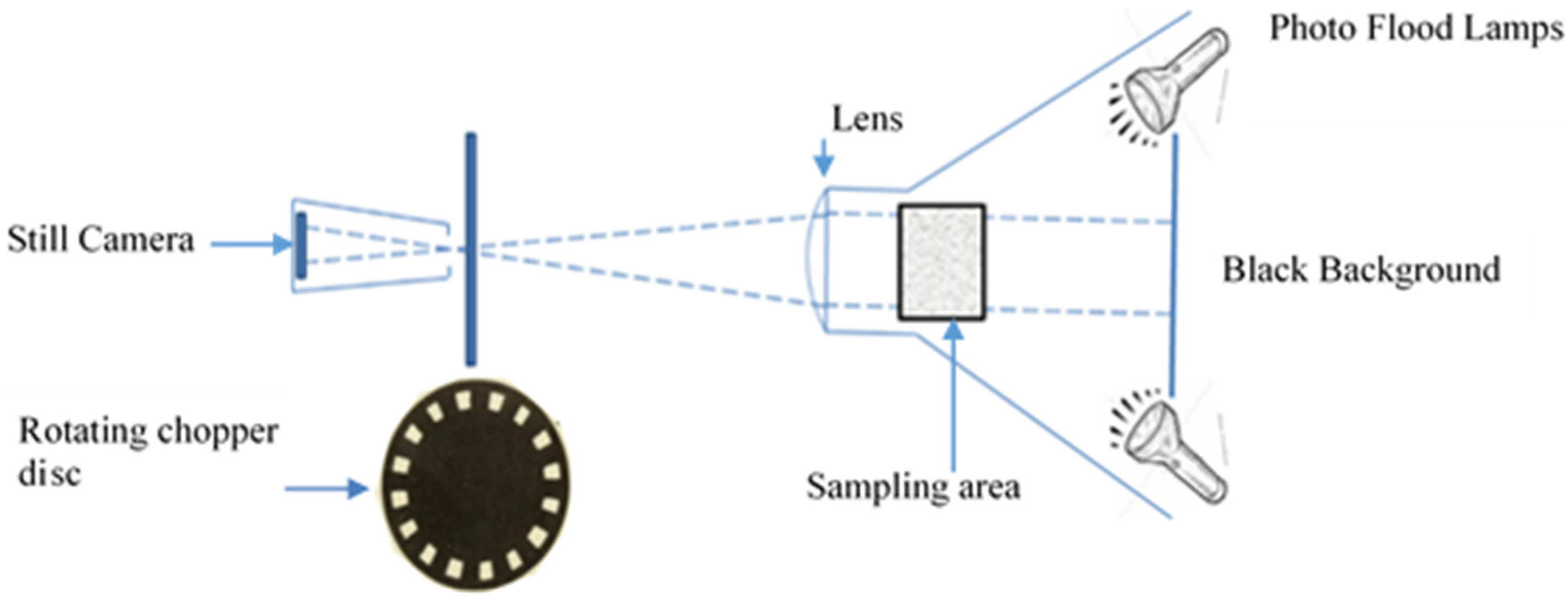
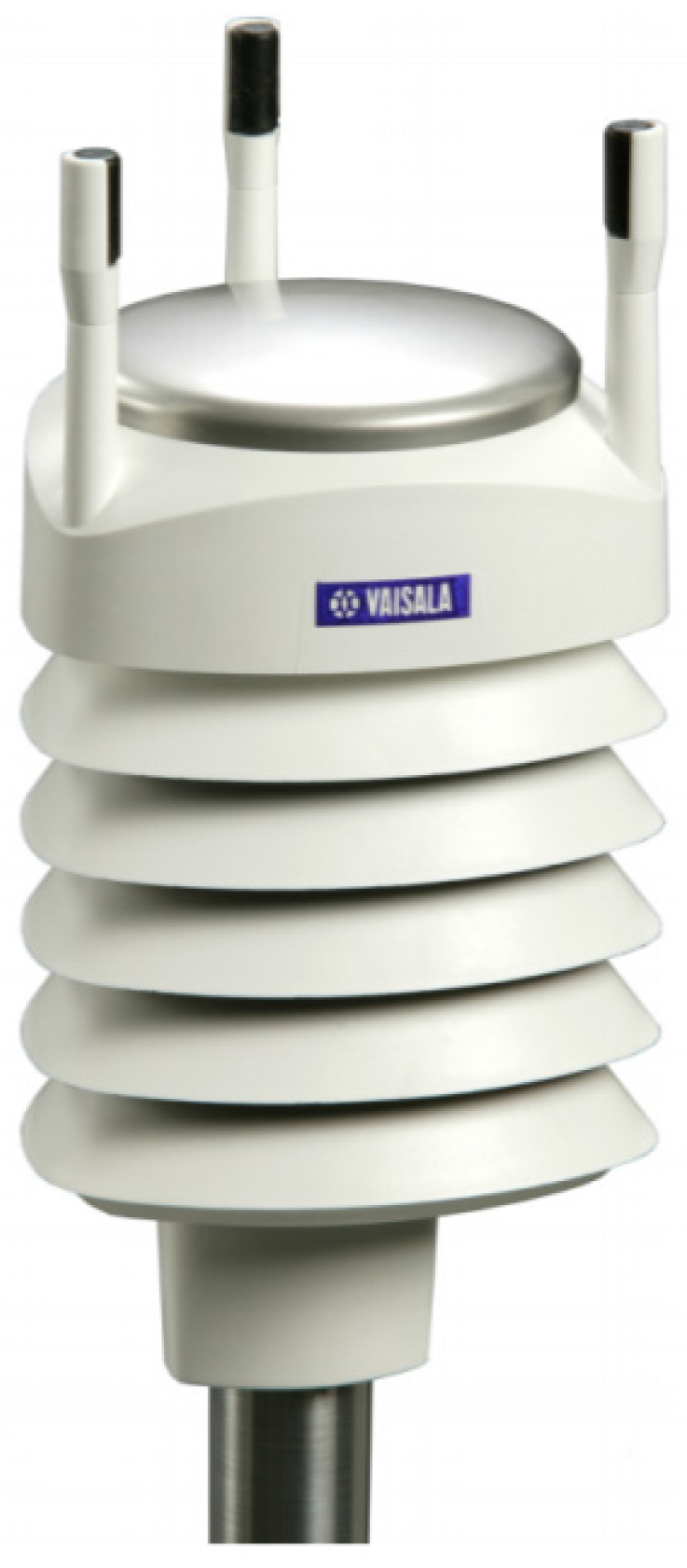
Figure 3. Vaisala Rain Cap disdrometer (Vaisala, Vantaa, Republic of finland)[82].
Figure iii. Vaisala Rain Cap disdrometer (Vaisala, Vantaa, Finland)[82].
iii. Automated Pelting Driblet Measurement Techniques
3.i. Affect Disdrometers
The kinetic free energy of rain drops is critical to soil erosion and stormwater pollutant wash off studies because it is indicative of the potential of drops to displace particles unremarkably bound to a surface, causing to soil particles to enter surface water flows. The combination of drop size distribution and drop velocity tin provide an estimation of kinetic energy, however there have been several previous attempts to take measurements directly [83,84,85]. This has been done using either audio-visual or displacement methods.
iii.i.one. Audio-visual Disdrometers
Acoustic disdrometers involve the generation and recording of an electrical betoken via a piezoelectric sensor when drops fall on a specialized diaphragm. Based on the relationship between kinetic energy and driblet size calculations [53,69], this electric point is converted to kinetic energy via the measured acoustic energy [73,83,84,85,86,87,88,89,90,91,92,93,94,95].
Modifications to the sensors used in acoustic disdrometers by Nystuen et al. [96] enabled employ in marine environments, however difficulties remained during high rainfall intensity measurement. Jayawardena and Rezaur [83] also successfully modified the acoustic disdrometers, and improved driblet size distribution, rain intensity and kinetic free energy measurement accuracy. Other commercial devices accept been successfully developed by Salmi and Ikonen [97], Salmi and Elomaa [84], Winder and Paulson [86], Bagree [98] and Vaisala [82] (Figure iii).
Limitations to accurateness in driblet size estimation arise using audio-visual disdrometers due to the difficulty in obtaining a compatible acoustic response over the entire diaphragm. Difficulties in the accurate measurement of smaller driblet sizes too remain because of insensitive diaphragms, and splash effects. In addition, higher intensity storms are not able to be measured due to background dissonance which decreases measurement accuracy.
three.1.ii. Displacement Disdrometers
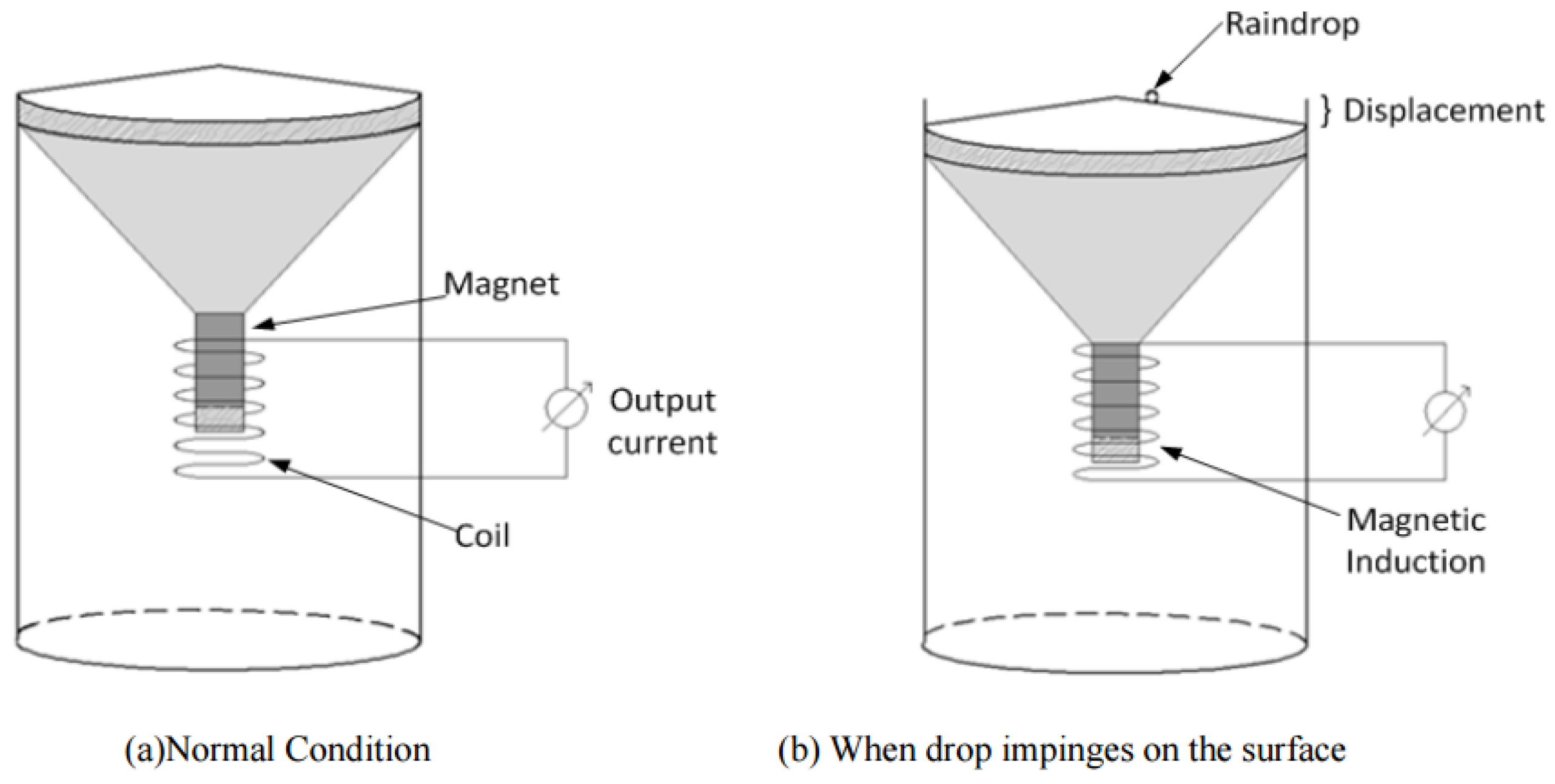
Energy generated by drops falling on the tiptop surface of a displacement disdrometer is translated via magnetic induction, and converted via electrical pulse to estimate the size of a pelting drib (Figure 4).
Effigy 4. Schematic of the principle of operation of deportation disdrometers [98].
Effigy 4. Schematic of the principle of performance of displacement disdrometers [98].
In addition to magnetic consecration, several mechanisms have previously been trialled to accurately measure drop size including elastic springs [98], bonded strain gauges [99], and pressure level transducers [84,100,101,102,103]. Arguably the most widely used displacement disdrometer is the Joss-Waldvogel Disdrometer [85] (Effigy 5) which has been commercially available for past 45 years. This unit of measurement has undergone several iterations to improve the composition of the cone which is the principle measurement component. Successful modifications have included the addition of a digital converter [104,105,106] (Table 3). Although this disdrometer may have provided advantages such as measurement over a broad range of drop sizes, and the ability to continuously sample over longer durations, limitations remain including authentic driblet counting, and authentic measurement of velocity, kinetic free energy, intensity, and drib shape.
Effigy 5. Joss-Waldvogel impact disdrometer (Distromet Ltd., Basel, Switzerland) [106].
Effigy 5. Joss-Waldvogel affect disdrometer (Distromet Ltd., Basel, Switzerland) [106].

Tabular array iii. Capability summary of a range of optical disdrometers.
| Device Proper noun | Report | Rainfall Intensity | Drop Size | Fall Speed | Kinetic Free energy | Sampling Expanse (Thickness of Light Beam) |
|---|---|---|---|---|---|---|
| Thies Clima® Laser Atmospheric precipitation Monitor (LPM) (Adolf Thies GmbH & Co. KG, Göttingen, Deutschland) | Bloemink & Lanzinger (2005) [107]; Clima (2007) [108]; Upton &Brawn (2008) [109]; Anderson (2009) [110]; de Moraes Frasson (2011) [111] | <250 mm/h | <8.5 mm | <eleven one thousand/s | Non Measurable | 45.6 cm2 (22.five cm × ii cm) |
| OTT Parsivel® disdrometer (OTT Hydromet, Loveland, Colorado, USA) | Krajewski et al. (2006) [112]; Thurai et al. (2009) [113]; Friedrich et al. (2013) [114] | <1200 mm/h | 0.2–5 mm | 0.2–20 m/s | <30 KJ | 54 cm2 (18 cm × 3 cm) |
| Particulate Measurement Arrangement (PMS) 2DG spectrometer (Particle Measuring Systems, Airport Blvd Bedrock, Colorado, USA) | Hawke (2003) [115] | Not Measurable | 0.fifteen–9.6 mm (in 64, 0.15 mm size categories) | <25 1000/s | Measurable | 100 mm2 |
| Paired-pulse optical disdrometer (P-POD) | Grossklaus et al. (1998) [116] | Not Measurable | 0.35–vi.4 mm | Measurable | Not Measurable | Cylindrical volume with 120 mm length and 22 mm bore |
| Particle Measuring Organisation GBPP-100S | Solomon et al. (1991) [117] | Measurable | 0.2–13 mm in 0.two mm increments | Measurable | Not Measurable | 13 × 500 mm2 |
| Paired pulse optical disdrometer (P-POD) | Illingworth and Stevens (1987) [118] | Not Measurable | 0.72–three.62 mm in 0.21 mm steps, <0.72 and >3.62 mm likewise detectable | Measurable | Not Measurable | Measurable |
| VIDIAZ spectro Pluvio meter | Donnadieu (1980) [119] | Not Measurable | >0.6 mm | Measurable | Non Measurable | eighty cm2 |
| Optical spectro pluviometer (OSP) | Picca &Trouilhet (1964) [120], Donnadieu et al. (1969) [121], Klaus (1977) [122], Hauser et al. (1984) [123], Salles & Poesen (1999) [124]; Salles et al. (1999) [125] | <35 mm/h underestimates intensity by 12%. >35 mm/h, underestimates intensity past 38%. | 0.3–4.7 mm (±6%) (Larger drops are detected merely without quantification of their bore) | 0.2–x chiliad/s | Not Measurable | Not reported |
three.2. Optical Disdrometers
Optical technologies (optical imaging or optical scattering) are non-intrusive rain drop measurement techniques. These methods do not influence drop behaviour during measurement, and have successfully resolved driblet suspension up, and drop splatter problems experienced past other measurement methods [126,127].
iii.2.1. Optical Imaging
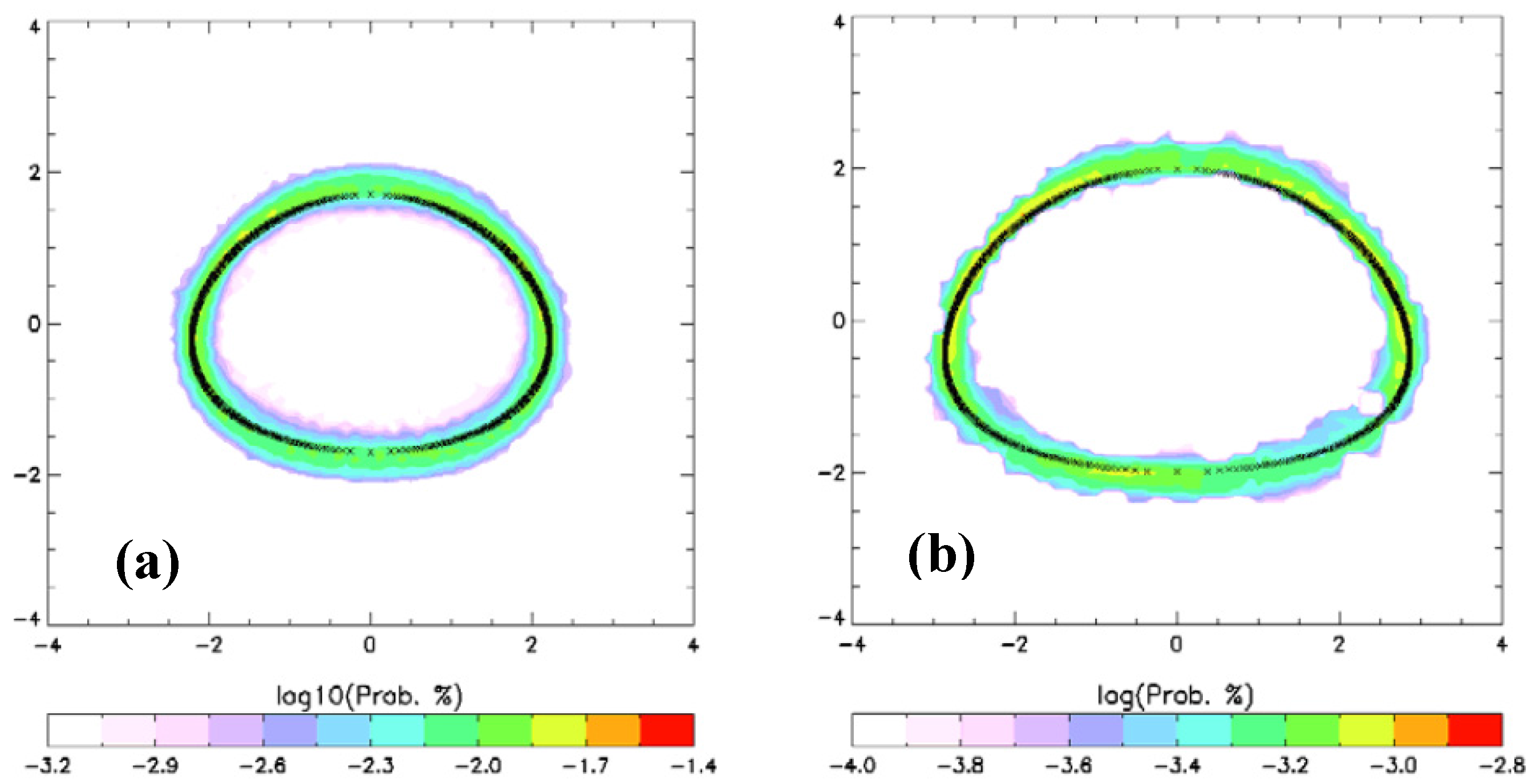
Recent imaging techniques adult have involved two motility cameras (2DVD) to show raindrop microstructure, including front and side drop contours, autumn velocity, drop cant and horizontal velocity. Full general rainfall parameters such equally pelting intensity and drop size distributions have also been accurately measured [128]. Two motion cameras record images of drops which have been used to accurately measure drop velocity, diameter, and shape (including oblateness, Effigy 6). Measurement errors arising from drib drift caused by the alpine unit of measurement design have led to design modifications, including the development of an indoor model [129], and one specifically designed for outdoor utilise [127].
Effigy half-dozen. Drop shapes in terms of probability of (a) 4 mm and (b) five mm obtained from 2DVD [113].
Figure 6. Drop shapes in terms of probability of (a) 4 mm and (b) five mm obtained from 2DVD [113].
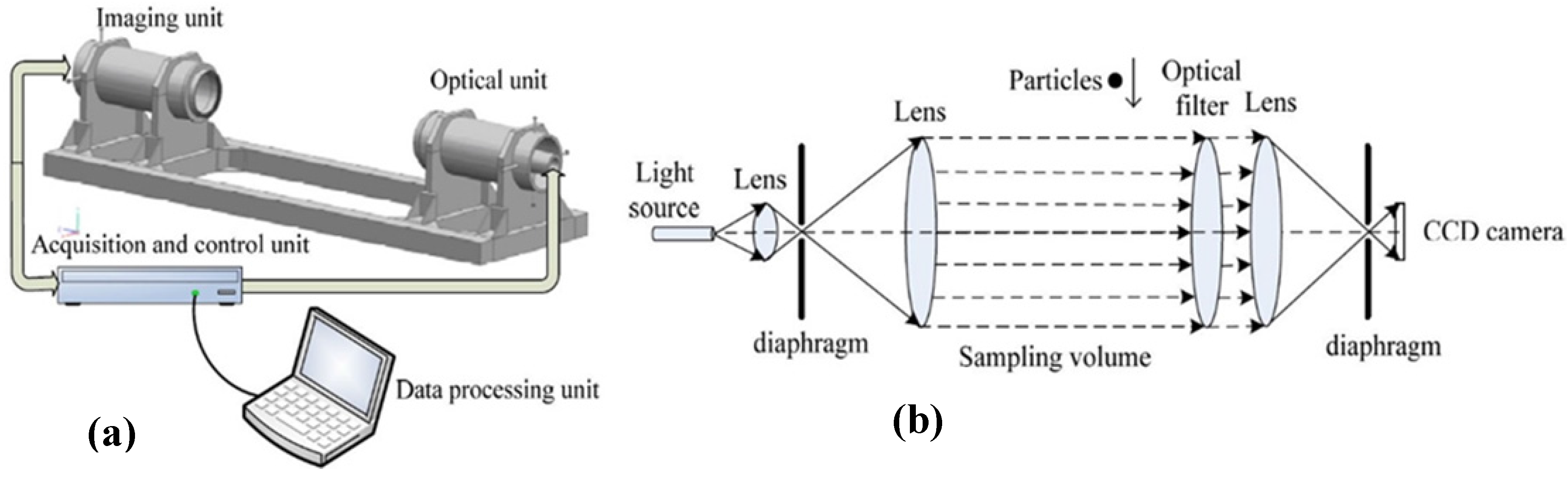
Liu et al. [130] developed a video arrangement capable of accurate drop shape and velocity measurement (Figure 7). The set up upwards consists of optical and processing units, and a unique imaging unit of measurement comprised of a planar assortment charge-coupled device (CCD) sensor. The shape, size, and velocity of drops tin can be accurately measured by a single CCD sensor.
Figure vii. (a) Video setup; (b) Schematic of imaging process [129].
Figure 7. (a) Video setup; (b) Schematic of imaging process [129].
iii.ii.2. Optical Scattering
Optical scattering techniques involve the generation of a horizontal low-cal axle which travels to a receiver where electrical measurements are taken. Drops that laissez passer through the light beam cause the lite to scatter. The attenuation of the light acquired by each drop is converted to an electrical pulse by the receiver which is then successfully converted to authentic drop velocity measurement [108] (Effigy eight).
Effigy 8. Schematic of optical disdrometer [108].
Figure eight. Schematic of optical disdrometer [108].
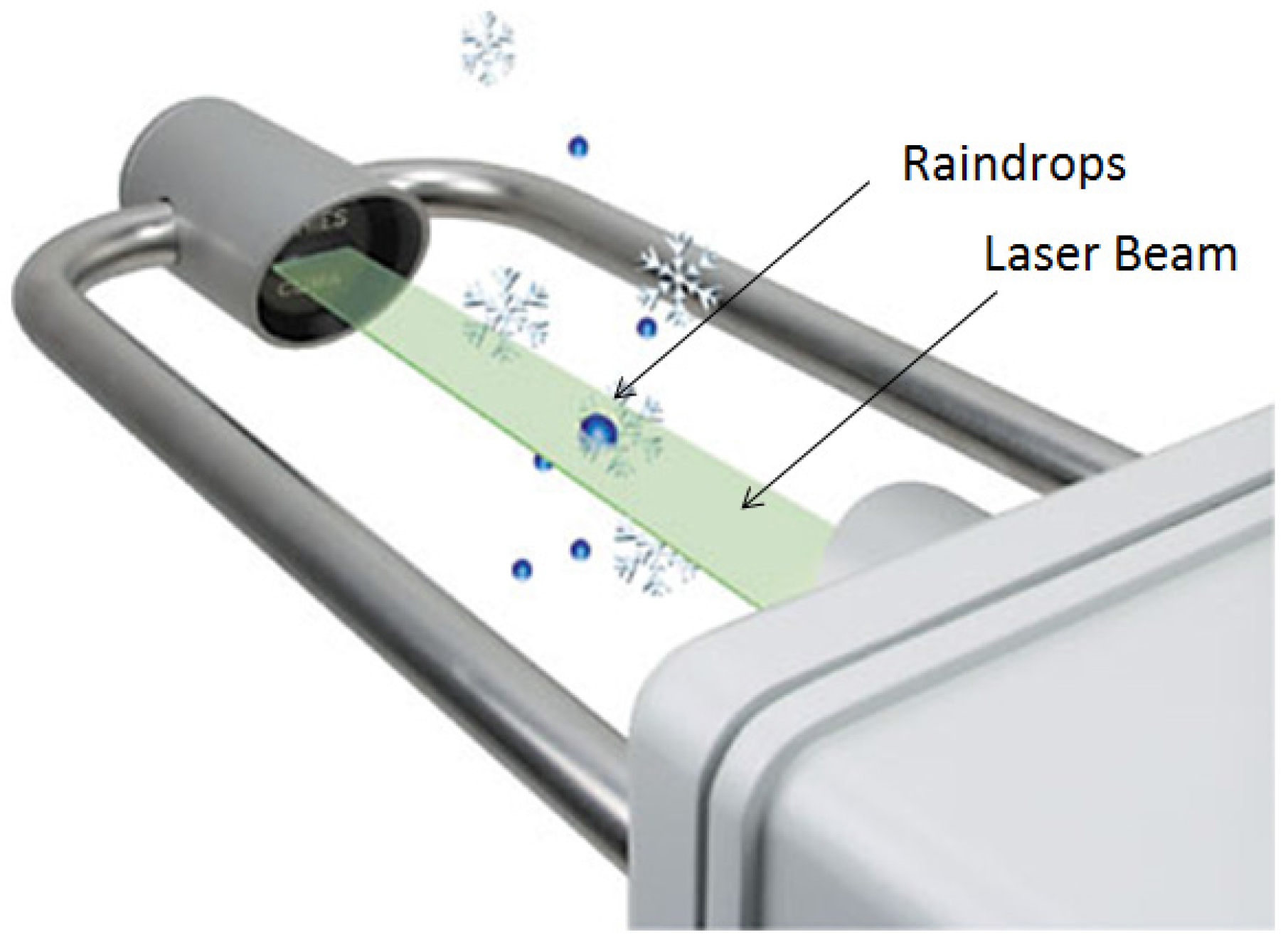
Since the mid-20th century, optical disdrometers have been used to successfully count and size individual rain drops [114,119,120,121,122,123,131,132,133,134] (Table four). Operation evaluations have suggested that optical disdrometers may be express to measuring larger drop sizes and that the rainfall intensity measurements were inaccurate [nine,124]. Although optical disdrometers have also been found to be sensitive to air current effects [116], a modified version [118] included a paired pulse and was successfully used in windy weather (wind speeds up to 20 chiliad/s). Several models are also capable of successfully differentiating betwixt solids and liquids, enabling use in the snowfall [135,136].
Table 4. Summary of the Characteristics of Pelting Droplet Measurement Techniques.
| Stain Method | FPM | Oil Immersion Technique | Photography Technique | JWD RD eighty & RD 69 Disdrometer | VR—WXT520 Disdrometer | 2 Dimensional Video Disdrometer | OTT Parsivel Disdrometer | Laser Optical Disdrometer | |
|---|---|---|---|---|---|---|---|---|---|
| Principle | Manual | Manual | Manual | Optical Technology | Bear on Displacement Technology | Impact Acoustic Technology | Optical Technology | Optical Laser Engineering | Optical Laser Technology |
| Measurability of larger drops | two.0 mm | 5 mm | 2.one mm | Non reported | five.0–v.5 mm | five.0 mm | Yes Range non reported | five.0–5.5 mm | eight.v mm |
| Measurability of smaller drops | 0.3 mm | 0.75 mm | Non reported | Not reported | 1.0 mm | 0.8 mm | Yep Range non reported | 0.2 mm | 0.125 mm |
| Measurability of counting the number of droplets | Yes | Yes | Yes | No | No | No | Yes | Yes | Yes |
| Measurability of the rain fall velocity | No | No | No | Yes | No | No | Yes | 20 m/south | 11 m/s |
| Measurability of the rain kinetic free energy | No | No | No | No | No | No | No | Yeah up to 30 kJ | No |
| Measurability of the rain intensity | No | No | No | No | No | No | Yes | Yeah | Yeah |
| Ability to business relationship the oblateness | No | No | No | No | No | No | Yep | No | No |
| Power to sampling continuously for longer durations | No | No | No | No | Yep | Yeah | Yes | Yep | Yep |
| Resilience to the wind furnishings | No | No | No | No | No | No | No | No | No |
| * Resolution | 127 classes | 8 classes | 1014 (32 size × 32 velocity) | 430 classes (23 × 20) | |||||
| Temporal resolution | 1 min | one min | 10 due south to 60 min | 1 min |
iv. Characteristics of a Robust Rainfall Droplet Measurement Technique
For a realistic prediction and monitoring of droplet characteristics, a robust rainfall measurement instrument must be able to:
-
Measure both larger (up to ten mm) and smaller (downwards to 0.3 mm) drop sizes precisely;
-
Count the drop sizes accurately;
-
Measure the fall velocity precisely;
-
Measure the rainfall intensities beyond all expected ranges;
-
Sample continuously; and
-
Tolerate wind effects while retaining drib measurement precision.
The possibility of achieving these target characteristics using the full range of available techniques is discussed beneath.
4.i. Precise Measurement of Larger Pelting Drops
Because larger rain drops (>half dozen mm) are correlated with larger pollution wash off from urban areas [110], their authentic measurement is essential to stormwater quality studies that apply rainfall simulation. Accurate transmission pelting drop measurement is limited to a maximum of approximately 2 mm in bore due to splashing effects distorting results [vii,17,137]. Big size drops are often overestimated due to the drib size growth over time on absorbent paper during utilize of the stain method [138]. The flour pellet method is express to measurement of drops larger than about 0.v mm due to sieve size limitations [5]. The measurement of larger drops using the oil immersion method is limited to 2.1 mm diameter due to drop splatter and amalgamation of drops [7,53,59].
Automated measurement techniques such as the bear on disdrometers are also limited to the measurement of drops less than v.five mm because of a reliance on calculations using the relationship between velocity-bore which plateaus across this diameter range using electric current formulae [53,113,139]. Although the two dimensional video and laser particle methods claim to accept the capacity to precisely mensurate drop sizes as big as 10 mm, peer reviewed studies to confirm this are yet to be published.
iv.2. Precise Measurement of Smaller Rain Drops
The accurate measurement of small raindrops is challenging using both manual and automated techniques. Manual raindrop measurement techniques are restricted to precise measurement of drops of greater than 0.3 mm diameter [15,33,44,59,61,66,140]. Automated measurement techniques are too restricted to measurement of drops greater than 1 mm in size [141].
Several studies reported difficulties in relation to touch disdrometers and the measurement of smaller raindrop diameters [85,134,142,143]. Intense rainfall causes splashing and vibrations is also reported to misconstrue the measurement of smaller drop sizes [142,144,145]. Measurement accuracy difficulties caused by light amplification by stimulated emission of radiation engineering recovery time (expressionless fourth dimension error), and noise distortion that affect the measurement of smaller drop sizes are known to restrict precise measurement to 1 mm effects [145,146,147,148].
Audio-visual disdrometers have limitations arising from the duration of the decaying waveform which when measured leads to distorted results [94,149]. Optical disdrometers claim to mensurate smaller drops with more precision, however, the reliability of these measurements remains unreported.
4.3. Accurate Measurement of the Number of Rain drops
Accurate measurement of the number of drops is critical for the generation of a drop size distribution for any given rainfall effect. This is the most widely used feature used to draw rainfall [150,151]. Manual measurement techniques have a skilful capacity to accurately count drop numbers over brusque durations. Automated disdrometers such as laser atmospheric precipitation monitors have the chapters to accurately sample over the longer durations required by rainfall sampling studies. Nevertheless, limitations on the measurement accuracy of drops below 0.two mm remain due to drib splatter [152] and background noise [112]. Optical disdrometers claim to accurately count drop numbers, however, the reliability of these measurements has as well not been verified or reported.
4.four. Precise Measurement of Rain Drop Velocity
Manual techniques are not capable of measuring driblet velocity with an acceptable level of precision [153]. Although limited to static measurements, and defined by frame capture rate per second, photographic techniques are capable of precise drop velocity measurement. Video technique measurement (2DVD), laser precipitation monitors, and optical spectral pluviometers can also provide precise, continuous drib velocity measurements.
iv.v. Power to Measure a Wide Range of Rainfall Intensities
Because of the particular features of each technique, none of the manual rain driblet measurement techniques, nor the impact disdrometer methods are capable of measuring rainfall intensity reliably. Although overestimation of higher rainfall intensities (>xx mm/h) is mutual, optical light amplification by stimulated emission of radiation and video (2DVD) measurement of rainfall intensity are generally accepted as more accurate [154]. Due to the limitations regarding accurate measurement of high rainfall intensities, it is recommended that optical laser techniques are used in combination with a conventional pluviometer to enable measurements to be verified and to ensure authentic rain intensity measurement.
iv.vi. Precise Measurement of Rain Drop Shape (Oblateness)
Initially spherical due to surface tension forces, with increasing size, fall velocity and drag forces, pelting drops tend to flatten out at the base, and sometimes develop a concave shape (Figure six). The caste of oblateness may bear on the kinetic energy of the drop, and thus the potential wash-off process caused by drop impact. Efforts to precisely measure out the oblateness of larger drops accept been limited, and it has been suggested that as even so, it may not be accurately described [155].
4.7. Chapters to Accurately Sample Rainfall over a Long Duration
Restricted sampling durations are synonymous with manual raindrop measurement techniques [156,157]. Automated disdrometers (laser, optical, acoustic, and impact) are known to measure rain drops in real time with virtually no time duration limitation. However, as discussed above, the accuracy of these devices can be express.
4.eight. Capacity to Perform Precise Pelting Drop Measurement during Adverse current of air Conditions
Considering sampling time is normally quite brief, all of the manual measurement techniques are known to be accurate (within their individual output limitations) during windy conditions. Air movement and wind dissonance around automated samplers (disdrometers, video, and acoustic) are known to influence rain drop trajectory and sound filtering, which have been shown to pb to inaccuracies in drop size measurements in previous studies [86,152,158]. Wind effects were reduced to an acceptable level in one previous study by tilting an audio-visual disdrometer parallel to air current direction [114]. However, this does non offer a reliable or permanent solution.
5. Summary and Decision
Every rainfall measurement technique has strengths and weaknesses and these generally result in some limitation in the accurateness of pelting drop characteristic measurements. The precise requirements of whatsoever proposed written report will determine the nearly advisable method or combination of methods that should exist used to produce the most suitable and authentic raindrop measurements. This is especially the example for stormwater management purposes, particularly in relation to understanding how dissimilar raindrop characteristics affect pollution launder off processes and how this influences stormwater runoff quality from urban areas.
The principal findings of this review have been:
-
The use of manual rain driblet measurement techniques take been successfully used in studies involving drib size measurements. However, these methods are generally non suitable for the measurement of smaller and larger drop sizes outside the normal range (0.3–6 mm), they are not capable of precise drop counts, they are not suitable for continuous rainfall monitoring studies, and they are less constructive during intense and windy storm conditions. In addition, manual rain drop measurement techniques cannot be used to measure or report drop velocity.
-
Automated (touch on and optical) disdrometers are generally able to sample continuously over long durations. Nonetheless, inaccuracies in drop size and velocity measurements are likely during heavy rain. Information technology is recommended that optical disdrometers should exist used in combination with a conventional rain guess to enable validation of results and ensure precise pelting intensity measurement.
The common limitations of all the rain drib measurement techniques includes their inability to precisely measure both the smaller, and the larger drop sizes outside the normal size range, their inaccuracy during high intensity rainfall events, and their reduced measurement precision during windy conditions. With improvements in technology occurring on a nearly daily basis, information technology is anticipated that the accuracy and precision of automated rainfall measurement techniques volition significantly amend in the nigh future. This will enable more than precise measurements to be undertaken and outcome in a much better agreement of real rainfall characteristics.
Author Contributions
All three authors contributed every bit to this manuscript.
Conflicts of Involvement
The authors declare no conflict of interest.
References
- Schönhuber, M.; Urban, H.; Baptista, J.P.; Randeu, W.Fifty.; Riedler, Due west. Measurements of precipitation characteristics past a new distrometer. In Proceedings of Atmospheric Physics and Dynamics in the Analysis and Prognosis of Precipitation Fields, Rome, Italy, 15–16 November 1994; pp. 15–eighteen.
- Testud, J.; Oury, Southward.; Black, R.A.; Amayenc, P.; Dou, X. The Concept of "Normalized" Distribution to Depict Raindrop Spectra: A Tool for Deject Physics and Cloud Remote Sensing. J. Appl. Meteorol. 2001, 40, 1118–1140. [Google Scholar] [CrossRef]
- Krajewski, Due west.F.; Ciach, 1000.J.; Habib, E. An analysis of small-calibration rainfall variability in unlike climatic regimes. Hydrol. Sci. J. 2003, 48, 151–162. [Google Scholar] [CrossRef]
- Herngren, L.F. Build-upwards and Wash-off Process Kinetics of PAHs and Heavy Metals on Paved Surfaces Using False Rainfall. Ph.D. Thesis, Queensland University of Engineering science, Brisbane, Commonwealth of australia, 2005. [Google Scholar]
- Hudson, N.W. Instrument for Studies of the Erosive Power of Rainfall, Erosion and Sediment Transport Measurement. In Proceedings of the Florence Symposium, 22-26 June 1981; International Association of Hydrological Sciences (IAHS): Ottawa, ON, Canada; pp. 383–393.
- Wiesner, J. Beitrage zur Kenntnis des troischen regens (About Contributions to the noesis of the tropical pelting). Atmos. Electr. 1895, 104, 1397–1434. [Google Scholar]
- Pearson, J.East.; Martin, G.East. An evaluation of raindrop sizing and counting techniques. Sci. Rep. 1957, 1, 1–17. [Google Scholar]
- Blanchard, D.C. Raindrop Size Distribution and Associated Phenomena in Hawaiian Rains; No. R52; Woods Hole Oceanographic Institution: Wood Pigsty, MA, Usa, 1952. [Google Scholar]
- Lowe, Due east.J. Rain drops. Q. J. R. Meteorol. Soc. 1892, 18, 242–245. [Google Scholar] [CrossRef]
- Marshall, J.South.; Palmer, W.M.Grand. The distribution of raindrops with size. J. Meteorol. 1948, five, 165–166. [Google Scholar] [CrossRef]
- Marshall, J.S.; Langille, R.C.; Palmer, W.M.Chiliad. Measurement of rainfall by radar. J. Meteorol. 1947, iv, 186–192. [Google Scholar] [CrossRef]
- Anderson, Fifty.J. Drop-size distribution measurements in orographic rain. Bull. Am. Met. Soc. 1948, 29, 362–366. [Google Scholar]
- Abudi, I.; Carmi, Thousand.; Berliner, P. Rainfall simulator for field runoff studies. J. Hydrol. 2012, 454, 76–81. [Google Scholar] [CrossRef]
- All-time, A.C. The size distribution of raindrops. Q. J. R. Meteorol. Soc. 1950, 76, sixteen–36. [Google Scholar] [CrossRef]
- Hall, Chiliad.J. Utilize of the stain method in determining the driblet-size distributions of coarse liquid sprays. Am. Soc. Agric. Eng. Trans. 1970, thirteen, 33–37. [Google Scholar] [CrossRef]
- Shiotsuki, Y. On the flat size distribution of drops from convective rainclouds. J. Meteorol. Soc. Jpn. 1974, 52, 42–60. [Google Scholar]
- Shiotsuki, Y. An interpretation of drop-size distribution in the severe rainfall. J. Meteorol. Soc. Jpn. 1976, 54, 259–263. [Google Scholar]
- Brandt, C.J. Transformation of the Kinetic Energy of Rainfall with Variable Tree Canopy. Ph.D. Thesis, Academy of London, London, United kingdom of great britain and northern ireland, 1986. [Google Scholar]
- Brandt, C.J. The transformation of rainfall free energy by a tropical pelting forest canopy in relation to soil erosion. J. Biogeogr. 1988, fifteen, 41–48. [Google Scholar] [CrossRef]
- Brandt, C.J. Simulation of the size distribution and erosivity of raindrops and throughfall drops. Earth Surf. Procedure. Landf. 1990, 15, 687–698. [Google Scholar] [CrossRef]
- Cerdà, A. Rainfall drib size distribution in the Western Mediterranean basin, València, Spain. Catena 1997, 30, 169–182. [Google Scholar] [CrossRef]
- Lu, J.Y.; Su, C.C.; Lu, T.F.; Maa, Chiliad.K. Number and volume raindrop size distributions in Taiwan. Hydrol. Procedure. 2008, 22, 2148–2158. [Google Scholar] [CrossRef]
- Bowen, Due east.Chiliad.; Davidson, K.A. A raindrop spectrograph. Q. J. R. Meteorol. Soc. 1951, 77, 445–449. [Google Scholar] [CrossRef]
- Blanchard, D.C. A simple recording technique for determining raindrop size and fourth dimension of occurrence of pelting showers. EOS Trans. Am. Geophys. Matrimony 1953, 34, 534–538. [Google Scholar] [CrossRef]
- Imai, I.; Fujiwara, M.; Ichimura, I.; Yoshihara, Z. On the radar reflectivity and the driblet-size distribution of pelting. J. Meteorol. Tokyo 1955, 7, 422–433. [Google Scholar]
- Spencer, A.T.; Blanchard, D.C. An Automated Raindrop Sampler; No. TR-11; Forest Hole Oceanographic Establishment: Wood Pigsty, MA, USA, 1956. [Google Scholar]
- Gillespie, T. The spreading of low vapor pressure liquids in newspaper. J. Colloid Sci. 1958, xiii, 32–50. [Google Scholar] [CrossRef]
- Becker, A. Zur messung der Tropfengroessen bei Regenfaellen nach der Absorption methode. (About measurement of drib sizes in rainfall according to the filter paper method). Meteorol. Z. 1907, 24, 247–261. [Google Scholar]
- Neuberger, H. Notes on measurement of rain-drib sizes. Bull. Am. Meteorol. Soc. 1942, 23, 274–276. [Google Scholar]
- Quinn, N.W.T. Backdrop of Transformed Simulated Rainfall under a Corn Canopy at Different Growth Stages and Row Widths. Masters Thesis, Iowa State University, Ames, IA, USA, 1981. [Google Scholar]
- Bentley, W.A. Studies of raindrops and raindrop phenomena. Monday. Weather condition Rev. 1904, 32, 450–456. [Google Scholar]
- Kohl, R.A. Drib size distributions from medium-sized agricultural sprinklers. Am. Soc. Agr. Eng. Trans. 1974, 17, 690–693. [Google Scholar] [CrossRef]
- Hudson, Due north.Due west. Raindrop size distribution in loftier intensity storms. Rhodesian J. Agric. Res. 1963, ane, six–11. [Google Scholar]
- Regmi, T.P.; Thompson, A.50. Rainfall simulator for laboratory studies. Appl. Eng. Agric. 2000, 16, 641–652. [Google Scholar] [CrossRef]
- Ogunye, F.O.; Boussabaine, H. Development of a rainfall exam rig as an aid in soil block weathering assessment. Constr. Build. Mater. 2002, 16, 173–180. [Google Scholar] [CrossRef]
- Júnior, S.S.; Siqueira, E.Q. Evolution and Calibration of a Rainfall Simulator for Urban Hydrology Enquiry. In Proceedings of 12th International Briefing on Urban Drainage, Porto Alegre, Brazil, eleven–16 September 2011; pp. 226–231.
- Lascelles, B.; Favis-Mortlock, D.T.; Parsons, A.J.; Guerra, A.J. Spatial and temporal variation in two rainfall simulators: Implications for spatially explicit rainfall simulation experiments. Earth Surf. Process. Landf. 2000, 25, 709–721. [Google Scholar] [CrossRef]
- Miguntanna, Northward.P. Nutrients build-up and wash-off processes in urban land uses. Ph.D. Thesis, Queensland University of Technology, Brisbane, Australia, 2009. [Google Scholar]
- Pérez-Latorre, F.J.; de Castro, 50.; Delgado, A. A comparison of two variable intensity rainfall simulators for runoff studies. Soil Tillage Res. 2010, 107, 11–16. [Google Scholar] [CrossRef]
- Arnaez, J.; Lasanta, T.; Ruiz-Flaño, P.; Ortigosa, L. Factors affecting runoff and erosion under false rainfall in Mediterranean vineyards. Soil Tillage Res. 2007, 93, 324–334. [Google Scholar] [CrossRef]
- Simone, A.; Vignali, V.; Bragalli, C.; Maglionico, Grand. Surface run-off: A rainfall simulator for wash-off modelling and route safety auditing under dissimilar rainfall intensities. In Proceedings of the second International SIIV Congress, Firenze, Italy, 27–29 October 2004.
- Parsons, A.J.; Rock, P.M. Effects of intra-storm variations in rainfall intensity on interrill runoff and erosion. Catena 2006, 67, 68–78. [Google Scholar] [CrossRef]
- Clarke, G.A.; Walsh, R.P. A portable rainfall simulator for field assessment of splash and slopewash in remote locations. Earth Surf. Procedure. Landf. 2007, 32, 2052–2069. [Google Scholar] [CrossRef]
- Egodawatta, P.G. Translation of Small-plot Scale Pollutant Build-up and Wash-off Measurements to Urban Catchment Scale. Ph.D. Thesis, Queensland Academy of Applied science, Brisbane, Australia, 2007. [Google Scholar]
- Asante, E.A. Effect of Mulch Blazon, Mulch Rate and Slope on Soil Loss, Runoff and Infiltration Under Simulated Rainfall for Two Agricultural Soils in Ghana. Ph.D. Thesis, Academy of Science and Technology, Kumasi, Ghana, 2011. [Google Scholar]
- Parsakhoo, A.; Lotfalian, M.; Kavian, A.; Hoseini, Due south.A.; Demir, M. Calibration of a portable single nozzle rainfall simulator for soil erodibility written report in hyrcanian forests. Afr. J. Agric. Res. 2012, 7, 3957–3963. [Google Scholar]
- Laws, J.O.; Parsons, D.A. The relation of raindrop size to intensity. Am. Geophysical Matrimony Trans. 1943, 26, 452–460. [Google Scholar] [CrossRef]
- Carter, C.E.; Greer, J.D.; Braud, H.J.; Floyd, J.M. Raindrop characteristics in South Key Usa. Am. Soc. Agric. Eng. Trans. 1974, 17, 1033–1037. [Google Scholar] [CrossRef]
- Navas, A.; Alberto, F.; Machín, J.; Galán, A. Design and operation of a rainfall simulator for field studies of runoff and soil erosion. Soil Technol. 1990, three, 385–397. [Google Scholar] [CrossRef]
- Fuchs, N.; Petrjanoff, I. Microscopic examination of fog, cloud and rain aerosol. Nature 1937, 139, 111–112. [Google Scholar] [CrossRef]
- May, K.R. The cascade impactor: An instrument for sampling coarse aerosols. J. Sci. Instrum. 1945, 22, 187–195. [Google Scholar] [CrossRef]
- Lane, West.R. A Microburette for producing small liquid drops of known size. J.Sci. Instrum. 1947, 24, 98–101. [Google Scholar] [CrossRef]
- Gunn, R.; Kinzer, G.D. The terminal velocity of autumn for water aerosol in brackish air. J. Meteorol. 1949, half dozen, 243–248. [Google Scholar] [CrossRef]
- Tate, R.W. Immersion sampling of spray aerosol. AIChE J. 1961, 7, 574–577. [Google Scholar] [CrossRef]
- Nawaby, A.Due south. A Method of Direct Measurement of Spray Droplets in an Oil Bath. J. Agric. Res. 1970, fifteen, 182–184. [Google Scholar] [CrossRef]
- McCool, D.K.; Williams, J.D.; Morse, J.R. Raindrop characteristics in the Pacific Northwest. In Proceedings of American Society of Agricultural and Biological Engineers (ASABE) Annual International Meeting, Reno, NV, USA, 11–xiv Oct 2009; Volume 97441, pp. 21–24.
- Eigel, J.D.; Moore, I.D. A simplified technique for measuring raindrop size and distribution. Amer. Soc. Agr. Eng. Trans. 1983, 24, 1079–1083. [Google Scholar] [CrossRef]
- Cruvinel, P.E.; Minatel, E.R.; Mucheroni, M.L.; Vieira, S.R.; Crestana, S. An Automatic Method Based on Paradigm Processing for Measurements of Drop Size Distribution from Agricultural Sprinklers. In Proceedings of Simpósio Brasileiro de Computação Gráfica e Processamento de Imagens (SIBGRAPI), Caxambú- Minas Gerais, Brazil, 29 October–1 Nov 1996; pp. 39–46.
- Courshee, R.J.; Byass, J.B. A Written report of the Methods of Measuring Small Spray Drops; National Institute of Agricultural Engineering: Bedford, UK, 1953. [Google Scholar]
- Hacker, P.T. An Oil-stream Photomicrographic Aeroscope for Obtaining Cloud Liquid-water Content and Droplet Size Distributions in Flight. National Advisory Committee for Aeronautics: Lewis Flight Propulsion Laboratory, Cleveland, OH, United states of america, 1956. Technical Notation 3592. pp. 1–36. Available online: http://digital.library.unt.edu/ark:/67531/metadc53544/m2/1/high_res_d/19810068735.pdf (accessed on x January 2016).
- Cruvinel, P.E.; Vieira, S.R.; Crestana, South.; Minatel, Due east.R.; Mucheroni, M.L.; Neto, A.T. Image processing in automated measurements of raindrop size and distribution. Comput. Electron. Agric. 1999, 23, 205–217. [Google Scholar] [CrossRef]
- Golitzine, N. Method for Measuring the Size of H2o Droplets in Clouds, Fogs, and Sprays; Note 6; National Aeronautical Institution: Ottowa, ON, Canada, 1951; pp. 1–52. [Google Scholar]
- Bigg, F.J.; Abel, Grand.C. Notation on Sampling and Photographing Cloud Droplets in Flying; RAE TN-ME-156; Purple Aircraft Establishment: Farnborough, UK, September 1953; pp. 46–57. [Google Scholar]
- Brown, E.North.; Willett, J.H. A three-slide deject droplet sampler. Bull. Am. Meteorol. Soc. 1955, 36, 123–127. [Google Scholar]
- Blanquies, J.; Scharff, Grand.; Hallock, B. The Design and Construction of a Rainfall Simulator, International Erosion Control Association (IECA). In Proceedings of 34th Annual Conference and Expo, Las Vegas, NV, U.s.a., 24–28 February 2003; p. 10.
- Houghton, H.K.; Radford, West.H. On the Measurement of Drop Size and Liquid H2o Content in Fogs and Clouds; Concrete Oceanography and Meteorology: Cambridge, MA, USA, 1938; Volume vi, pp. 5–31. [Google Scholar]
- Baumgardner, D.; Jonsson, H.; Dawson, W.; O'Connor, D.; Newton, R. The cloud, aerosol and precipitation spectrometer: A new musical instrument for cloud investigations. Atmos. Res. 2001, 59–60, 251–264. [Google Scholar] [CrossRef]
- Mache, H. Ueber die Geschwindigkeit un Grosse der Regentrpfen. Meteorol. Z. 1904, 39, 278. [Google Scholar]
- Laws, J.O. Measurements of the fall-velocity of water-drops and raindrops. Am. Geophys. Union Trans. 1941, 22, 709–721. [Google Scholar] [CrossRef]
- Mason, B.J.; Ramanadham, R. A photoelectric raindrop spectrometer. Q. J. R. Meteorol. Soc. 1953, 79, 490–495. [Google Scholar] [CrossRef]
- Mikirov, A.E. A photoelectric method of investigating the distribution of particle size precipitation. Izv. Akad. Nauk. SSSR 1957, i, 104. [Google Scholar]
- Salvador, R.; Bautista-Capetillo, C.; Burguete, J.; Zapata, N.; Serreta, A.; Playán, E. A photographic method for driblet characterization in agricultural sprinklers. Irrig. Sci. 2009, 27, 307–317. [Google Scholar] [CrossRef]
- De Jong, S. Depression Toll Disdrometer. Masters Thesis, Delf University of Technology, Delft, The netherlands, 2010. [Google Scholar]
- Sadeghi, S.H.; Abdollahi, Z.; Darvishan, A.Yard. Experimental comparison of some techniques for estimating natural raindrop size distribution on the south coast of the Caspian Body of water, Iran. Hydrol. Sci. J. 2013, 58, 1374–1382. [Google Scholar] [CrossRef]
- Sudheer, M.P.; Panda, R.K. Digital image processing for determining drop sizes from irrigation spray nozzles. Agric. W. Manag. 2000, 45, 159–167. [Google Scholar] [CrossRef]
- Kincaid, D.C.; Solomon, K.H.; Oliphant, J.C. Drib size distributions for irrigation sprinklers. Amer. Soc. Agr. Eng. Trans. 1996, 39, 839–845. [Google Scholar] [CrossRef]
- Mueller, East.A. Radar cross sections from driblet size spectra. Ph.D. Thesis, University of Illinois at Urbana-Champaign, Champaign, IL, United states, 1966. [Google Scholar]
- Jones, D.M. The shape of raindrops. J. Meteorol. 1959, 16, 504–510. [Google Scholar] [CrossRef]
- Jones, D.M.; Dean, L.A. A Raindrop Camera; Illinois Land Water Survey: Champaign, IL, The states, 1953. [Google Scholar]
- Jones, D.M. Rainfall Driblet Size-distribution and Radar Reflectivity; Defence Technical Information Eye, Signal Corps Engineering Laboratories: Fort Monmouth, NJ, Us, 1956. [Google Scholar]
- Fujiwara, One thousand. Raindrop-size distribution from individual storms. J. Atmos. Sci. 1965, 22, 585–591. [Google Scholar] [CrossRef]
- Vaisala. Vaisala Atmospheric condition Transmitter WXT510 with the Vaisala RAINCAP® Sensor. 2012, 1. Bachelor online: world wide web.vaisala.com (accessed on 15 June 2015).
- Jayawardena, A.W.; Rezaur, R.B. Measuring drop size distribution and kinetic energy of rainfall using a force transducer. Hydrol. Procedure. 2000, 14, 37–49. [Google Scholar] [CrossRef]
- Salmi, A.; Elomaa, Fifty. Measurements of the Terminal Velocity and Shape of Falling Raindrops at Vaisala Rain Laboratory. In Proceedings of Eighth European Briefing on Application of Meteorology (ECAM), San Lorenzo de El Escorial, Espana, 1–5 Oct 2007; pp. 55–61.
- Kinnell, P.I.A. Some observations on the Joss-Waldvogel rainfall disdrometer. J. Appl. Meteorol. 1976, 15, 499–502. [Google Scholar] [CrossRef]
- Winder, P.; Paulson, K.Southward. The measurement of rain kinetic energy and rain intensity using an audio-visual disdrometer. Meas. Sci. Technol. 2012, 23, 015801. [Google Scholar] [CrossRef]
- Schindelhauer, F. Versuch einer Registrierung der Tropfenzahl bei Regenfallen (An Attempt to Tape the Number of Drops in Rain); Scientific Report No. 1; Meteorologische Zeitschrift: Brunswick, Germany, 1925; pp. 25–27. [Google Scholar]
- Perez, A.A. The Analysis and Preliminary Synthesis of a Drop Size Distribution Measuring Organization; Massachusetts Institute of Technology: Cambridge, MA, USA, 1949. [Google Scholar]
- Cooper, B.F. A Balloon-borne Instrument for Telemetering Raindrop-size Distribution and Rainwater Content of Cloud. Aust. J. Appl. Sci. 1951, 2, 43–55. [Google Scholar]
- Maulard, J. Mensurate du Nombre de Gouttes de Pluie (Measurement of the number of drops of rain). J. Sci. Meteorol. 1951, three, 69–73. [Google Scholar]
- Katz, I. A momentum disdrometer for measuring raindrop size from aircraft. Balderdash. Am. Meteorol. Soc. 1952, 33, 365–368. [Google Scholar]
- Smulowicz, B. Assay of the Impactometer: An Instrument for Measuring the Distribution of Raindrop Sizes Encountered in Flying. Ph.D. Thesis, Massachusetts Institute of Technology, Cambridge, MA, U.s.a., 1952. [Google Scholar]
- Adderley, E.East. The growth of raindrops in cloud. Q. J. R. Meteorol. Soc. 1953, 79, 380–388. [Google Scholar] [CrossRef]
- Kinnell, P.I.A. The acoustic measurement of h2o-drop impacts. J. Appl. Meteorol. 1972, 11, 691–694. [Google Scholar] [CrossRef]
- Kimble, P.D. Measuring the Momentum of Throughfall Drops and Raindrops. Ph.D. Thesis, Western Kentucky Academy, Bowling Greenish, KY, Us, 1996. [Google Scholar]
- Nystuen, J.A. Relative operation of automatic pelting gauges under different rainfall conditions. J. Atmos. Ocean. Technol. 1999, 16, 1025–1043. [Google Scholar] [CrossRef]
- Salmi, A.; Ikonen, J. New piezoelectric Vaisala RAINCAPÒ precipitation sensor. In Proceedings of 19th Conference of Hydrology. Meteorolgical Society, San Diego, CA, USA, 9–13 January 2005; pp. 2–6.
- Bagree, R. Characterization and Pattern of a Readout Circuit for a Piezoelectric-based Acoustic Disdrometer. Ph.D. Thesis, Delft University of Technology, Delft, Holland, 2012. [Google Scholar]
- Neal, J.H.; Baver, L.D. Measuring the impact of raindrops. Agron. J. 1937, 29, 708–709. [Google Scholar] [CrossRef]
- Webster, D.One thousand. An Investigation into the Employ of Microprocessors for the Measurement of Rainfall Intensity; National College of Agricultural Engineering: Silsoe, Bedfordshire, Great britain, 1980. [Google Scholar]
- Bass, H.G. Introduction to Engineering Measurements; McGraw-Loma Pedagogy: Columbus, OH, USA, 1971. [Google Scholar]
- Henry, Z.A.; Zoerb, G.C.; Nascence, G.S. Instrumentation and Measurement for Environmental Sciences; SP-0375; American Society of Agronomical Engineers: St. Joseph, MI, USA, 1991; pp. 5–91. [Google Scholar]
- Joss, J.; Waldvogel, A. Ein spektrograph für niederschlagstropfen mit automatischer auswertung. Pure Appl. Geophys. 1967, 68, 240–246. [Google Scholar] [CrossRef]
- Kinnell, P.I.A. Some observations on Joss-Waldvogel rainfall disdrometer-respond. J. Appl. Meteorol. 1977, 16, 113–114. [Google Scholar] [CrossRef]
- Joss, J.; Waldvogel, A. Some observations on Joss–Waldvogel rainfall disdrometer—Respond. J. Appl. Meteorol. 1977, 16, 112–113. [Google Scholar] [CrossRef]
- Distromet Ltd. Distromet. 2011. Bachelor online: www.distromet.com (accessed on fifteen June 2015).
- Bloemink, H.I.; Lanzinger, E. Precipitation type from the Thies disdrometer. In Instruments and Observing Methods Study 82 (TD1265), In Proceedings of World Meterological Organization Technical Briefing on Instruments and Methods of Observation (TECO-2005), Bucharest, Romania, four–7 May 2005.
- Clima, T. Laser Precipitation Monitor Instruction for Use: 5.4110.X0.X00; Software Version one.04; Adolf Thies GmbH & Co. KG: Göttingen, Federal republic of germany, 2007. [Google Scholar]
- Upton, Grand.; Brawn, D. An investigation of factors affecting the accuracy of Thies disdrometers. In Proceedings of Globe Meterological Organization Technical Briefing on Instruments and Methods of Observation (TECO-2008), St. petersburg, Russian Federation, 27–29 November 2008; pp. 27–29.
- Anderson, D. Preliminary evaluation of OTT and Thies Clima present weather sensors. Program operations and standards Musical instrument Test Report 691; Bureau of Meteorology, Australian Authorities: Melbourne, Australia, 2009. [Google Scholar]
- De Moraes Frasson, R.P.; da Cunha, L.K.; Krajewski, West.F. Assessment of the Thies optical disdrometer functioning. Atmos. Res. 2011, 101, 237–255. [Google Scholar] [CrossRef]
- Krajewski, W.F.; Kruger, A.; Caracciolo, C.; Golé, P.; Barthes, L.; Creutin, J.D.; Vinson, J.P. DEVEX-disdrometer evaluation experiment: Basic results and implications for hydrologic studies. Adv. W. Res. 2006, 29, 311–325. [Google Scholar] [CrossRef]
- Thurai, M.; Bringi, Five.N.; Petersen, W.A. Rain microstructure retrievals using 2-D video disdrometer and C-ring polarimetric radar. Adv. Geosci. 2009, twenty, thirteen–18. [Google Scholar] [CrossRef]
- Friedrich, K.; Higgins, S.; Masters, F.J.; Lopez, C.R. Articulating and stationary PARSIVEL disdrometer measurements in weather with strong winds and heavy rainfall. J. Atmos. Body of water. Technol. 2013, 30, 2063–2080. [Google Scholar] [CrossRef]
- Hawke, R.M. Using a spectrometer to appraise simulated rainfall: Research in action. South. Afr. J. Scientific discipline 2003, 99, 311. [Google Scholar]
- Grossklaus, Chiliad.; Uhlig, Chiliad.; Hasse, L. An optical disdrometer for apply in high wind speeds. J. Atmos. Sea. Technol. 1998, 15, 1051–1059. [Google Scholar] [CrossRef]
- Solomon, One thousand.H.; Zoldoske, D.E.; Oliphant, J.C. Laser Optical measurement of Sprinkler Drop Sizes. In Proceedings of Automated Agriculture for the 21st Century, St. Joseph, MI, U.s., sixteen–17 December 1991; pp. 87–96.
- Illingworth, A.J.; Stevens, C.J. An optical disdrometer for the measurement of raindrop size spectra in windy weather. J. Atmos. Ocean. Technol. 1987, 4, 411–421. [Google Scholar] [CrossRef]
- Donnadieu, One thousand. Comparison of results obtained with the VIDIAZ spectropluviometer and the Joss-Waldvogel rainfall disdrometer in a "pelting of a thundery blazon". J. Appl. Meteorol. 1980, nineteen, 593–597. [Google Scholar] [CrossRef]
- Picca, B.; Trouilhet, Thou. Un pluviogranulometre photoelectrique (A photoelectric raindrop-size spectrometer). J. Atmos. Res. 1964, 7, 184–188. [Google Scholar]
- Donnadieu, Thousand.; Dubosclard, G.; Godard, Due south. Un pluviometre ohotoelctrique cascade la conclusion simultanee des spectres dimensionnel at de vitesse de chute des gouttes de pluie. J. Res. Atmos. 1969, 4, 37–46. [Google Scholar]
- Klaus, V. Report Spectropluviomètre Photoelectric Providing Existent-fourth dimension Integrated Parameters. Ph.D. Thesis, Academy of Paris, Paris, France, 1977. [Google Scholar]
- Hauser, D.; Amayenc, P.; Nutten, B.; Waldteufel, P. A new optical instrument for simultaneous measurement of raindrop diameter and autumn speed distributions. J. Atmos. Ocean. Technol. 1984, 1, 256–269. [Google Scholar] [CrossRef]
- Salles, C.; Poesen, J. Operation of an optical spectro pluviometer in measuring basic rain erosivity characteristics. J. Hydrol. 1999, 218, 142–156. [Google Scholar] [CrossRef]
- Salles, C.; Poesen, J.; Borselli, 50. Measurement of Simulated Drop Size Distribution with an Optical Spectro Pluviometer: Sample Size Considerations. World Surf. Process. Landf. 1999, 24, 545–556. [Google Scholar] [CrossRef]
- Lanzinger, E.; Theel, One thousand.; Windolph, H. Rainfall amount and intensity measured by the Thies laser precipitation monitor. In Instruments and Observing Method Report No. 94, 1–97, Proceedings of TECO-2006-WMO Technical Conference on Meteorological and Environmental Instruments and Methods of Observation, 4–vi December 2006; World Meteorological Organization: Geneva, Switherland, 2006. [Google Scholar]
- Schönhuber, M.; Lammer, G.; Randeu, Westward.Fifty. The 2D-video-distrometer. In Atmospheric precipitation: Advances in Measurement, Estimation and Prediction; Springer: Berlin, Federal republic of germany, 2008; pp. iii–31. [Google Scholar]
- Schönhuber, Thou.; Lammer, G.; Randeu, W.50. I decade of imaging precipitation measurement past 2D-video-distrometer. Adv. Geosci. 2007, x, 85–90. [Google Scholar] [CrossRef]
- Nešpor, 5.; Krajewski, W.F.; Kruger, A. Wind-induced error of raindrop size distribution measurement using a ii-dimensional video disdrometer. J. Atmos. Ocean. Technol. 2000, 17, 1483–1492. [Google Scholar] [CrossRef]
- Liu, X.C.; Gao, T.C.; Liu, L. A video atmospheric precipitation sensor for imaging and velocimetry of hydrometeors. Atmos. Meas. Tech. 2014, 7, 2037–2046. [Google Scholar] [CrossRef]
- Gucker, F.T., Jr. Determination of concentration and size of particulate matter by lite scattering and sonic techniques. In Proceedings of Offset National Air Pollution Symposium, x–xi Nov 1949; Stanford Inquiry Institute: Los Angeles, CA, The states; pp. 14–25.
- Knollenberg, R.G. The optical array: An alternative to scattering or extinction for airborne particle size decision. J. Appl. Meteorol. 1970, 9, 86–103. [Google Scholar] [CrossRef]
- Knollenberg, R.G. Three new instruments for cloud physics measurements: The 2-D spectrometer, the forward scattering Spectrometer probe and the agile scattering droplets spectrometer. In Proceedings of International Conference on Cloud Physics, Boulder, Colo., American Meteorological Guild, Boston, MA, United states of america, 26–xxx July 1976; pp. 544–561.
- Löffler-Mang, G.; Joss, J. An optical disdrometer for measuring size and velocity of hydrometeors. J. Atmos. Bounding main. Technol. 2000, 17, 130–139. [Google Scholar] [CrossRef]
- Battaglia, A.; Rustemeier, E.; Tokay, A.; Blahak, U.; Simmer, C. PARSIVEL snow observations: A critical cess. J. Atmos. Ocean. Technol. 2010, 27, 333–344. [Google Scholar] [CrossRef]
- Jaffrain, J.; Berne, A. Experimental quantification of the sampling uncertainty associated with measurements from PARSIVEL disdrometers. J. Hydrometeorol. 2011, 12, 352–370. [Google Scholar] [CrossRef]
- Dingle, A.Due north.; Schulte, H.F., Jr. A inquiry instrument for the study of raindrop-size spectra. J. Appl. Meteorol. 1962, 1, 48–59. [Google Scholar] [CrossRef]
- Bricklayer, B.J.; Andrews, J.B. Drop-size distributions from diverse types of rain. Q. J. R. Meteorol. Soc. 1960, 86, 346–353. [Google Scholar] [CrossRef]
- Atlas, D.; Srivastava, R.C.; Sckhon, R.S. Doppler radar characteristics of precipitation at vertical incidence. Rev. Geophys. Sp. Phys. 1973, eleven, i–35. [Google Scholar] [CrossRef]
- Kobayaski, T. Measurement of Rain-driblet Size past Means of Photographic Paper Treated with COCltwo. J. Meteor. Soc. Jpn. 1995, 33, 217. [Google Scholar]
- Roy, S.S.; Datta, R.G.; Bhatia, R.C.; Sharma, A.K. Drib size distributions of tropical rain over due south Bharat. Geofizika 2005, 22, 105–131. [Google Scholar]
- Listing, R.A. Linear radar reflectivity-rainrate relationship for steady tropical rain. J. Atmos. Sci. 1988, 45, 3564–3572. [Google Scholar] [CrossRef]
- Tokay, A.; Kruger, A.; Krajewski, W.F. Comparison of drop size distribution measurements by impact and optical disdrometers. J. Appl. Meteorol. 2001, twoscore, 2083–2097. [Google Scholar] [CrossRef]
- Nystuen, J.A.; Proni, J.R.; Lauter, C.A.; Bufkin, J.; Rivero, U.; Boland, Thou.; Wilkerson, J.C. APL Disdrometer Evaluation; National Oceanic and Atmospheric Administration/Environmental Enquiry Laboratories Technical Memorandum ERL AMOL-83 (PB95-181681): Miami, FL, USA, 1994. [Google Scholar]
- Harikumar, R.; Sampath, S.; Kumar, V.S. An empirical model for the variation of rain drop size distribution with rain rate at a few locations in southern India. Adv. Sp. Res. 2009, 43, 837–844. [Google Scholar] [CrossRef]
- Sheppard, B.Eastward.; Joe, P.I. Comparison of raindrop size distribution measurements past a Joss-Waldvogel disdrometer, a PMS 2DG spectrometer, and a POSS Doppler radar. J. Atmos. Body of water. Technol. 1994, 11, 874–887. [Google Scholar] [CrossRef]
- Tokay, A.; Bashor, P.G.; Habib, E.; Kasparis, T. Raindrop size distribution measurements in tropical cyclones. Monday. Weather Rev. 2008, 136, 1669–1685. [Google Scholar] [CrossRef]
- Das, S.; Maitra, A.; Shukla, A.1000. Pelting attenuation modeling in the 10-100 GHz frequency using drib size distributions for different climatic zones in tropical Republic of india. Prog. Electromagn. Res. B 2010, 25, 211–224. [Google Scholar] [CrossRef]
- De Wulf, F.D.; Gabriels, D.; Boodt, Thousand.D. A device for analyzing the energy load of rainstorms. Assess. Eros. 1980, 165–167. [Google Scholar]
- Campos, E.F.; Zawadzki, I.; Petitdidier, M.; Fernandez, Westward. Measurement of raindrop size distributions in tropical rain at Costa Rica. J. Hydrol. 2006, 328, 98–109. [Google Scholar] [CrossRef]
- Konwar, M.; Sarma, D.Chiliad.; Das, J.; Sharma, Southward. Shape of the pelting drop size distributions and nomenclature of pelting type at Gadanki. Indian J. Radio Sp. Phys. 2006, 35, 360–367. [Google Scholar]
- Kruger, A.; Krajewski, West.F. Two-dimensional video disdrometer: A description. J. Atmos. Ocean. Technol. 2002, 19, 602–617. [Google Scholar] [CrossRef]
- Montero-Martínez, G.; Kostinski, A.B.; Shaw, R.A.; García-García, F. Do all raindrops fall at final speed? Geophysical Res. Lett. 2009, 36, one–4. [Google Scholar] [CrossRef]
- practise Khac, K.; Zanghi, F.; Tabary, P. Radar-disdrometer comparing. In Proceedings of Third European Conference on Radar Meteorology and Hydrology (ERAD), Visby, Sweden, 6–10 September 2004; pp. 272–277.
- Beard, K.V.; Bringi, V.Due north.; Thurai, M. A new understanding of raindrop shape. Atmos. Res. 2010, 97, 396–415. [Google Scholar] [CrossRef]
- Erpul, G.; Gabriels, D.; Janssens, D. Assessing the drop size distribution of simulated rainfall in a wind tunnel. Soil Tillage Res. 1998, 45, 455–463. [Google Scholar] [CrossRef]
- Salles, C.; Poesen, J.; Sempere-Torres, D. Kinetic free energy of rain and its functional relationship with intensity. J. Hydrol. 2002, 257, 256–270. [Google Scholar] [CrossRef]
- Habib, E.; Krajewski, W.F. An example of computational approach used for aerodynamic design of a pelting disdrometer. J. Hydraul. Res. 2001, 39, 425–428. [Google Scholar] [CrossRef]
© 2022 past the authors; licensee MDPI, Basel, Switzerland. This commodity is an open access article distributed under the terms and conditions of the Creative Commons by Attribution (CC-BY) license (http://creativecommons.org/licenses/by/4.0/)
wagonerthallusithe.blogspot.com
Source: https://www.mdpi.com/2073-4441/8/1/29/htm
0 Response to "Does the Size of Rain Drops Affect Rain Gauge Reading"
Mag-post ng isang Komento